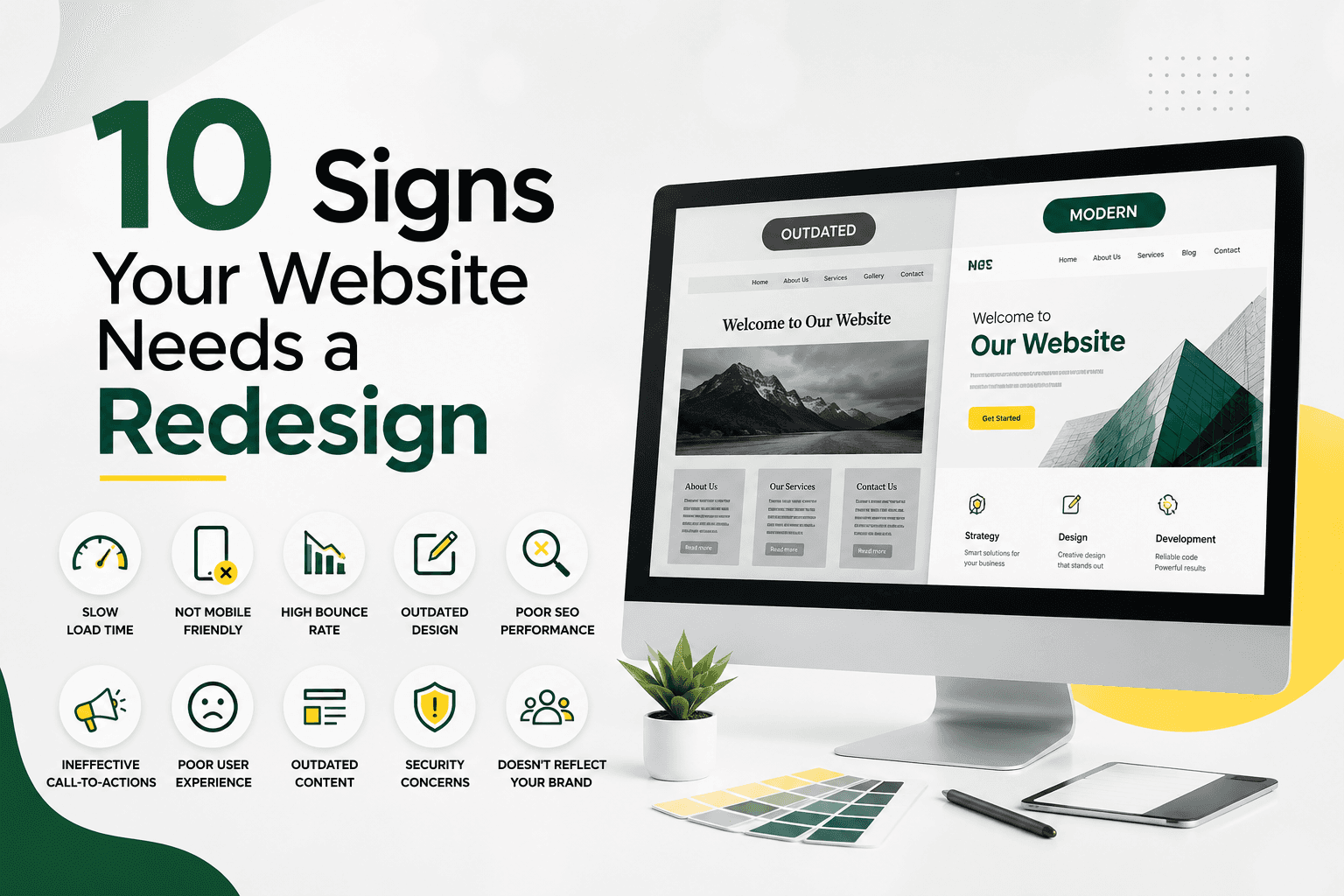
Ever land on a website and click away within seconds - without even reading a word? That instinct fires faster than most business owners realize, and it might be happening to your visitors right now. If your website hasn't been touched in a few years, or if it just feels "off" without you being able to say why, there's a good chance it's quietly costing you customers. This blog walks through the clearest signs your website needs a redesign, so you can tell whether it's time for a refresh or a full rebuild.
1. Your Bounce Rate Is Climbing
If people are leaving your site almost as fast as they arrive, that's rarely a coincidence. A high bounce rate usually means visitors aren't finding what they expected within the first few seconds.
- Check whether your homepage clearly communicates what you do and who you serve
- Look at whether your load time is dragging visitors away before the page even finishes rendering
- Compare bounce rates across your top landing pages to spot patterns
2. It Doesn't Work Well on Mobile
Most of your visitors are almost certainly browsing from their phones. If your site was built years ago without mobile-first design in mind, buttons may be too small, text may overflow, or menus may break entirely on smaller screens.
A site that looks great on a laptop but frustrating on a phone isn't fully functional anymore - it's only half-built for how people actually browse today.
3. Your Design Looks Dated
Design trends shift, and so do visitor expectations. Clunky sliders, tiny fonts, cluttered layouts, or stock photos that feel a decade old all send a subtle signal: this business hasn't kept up.
Think of it this way - a redesign isn't about chasing trends for their own sake. It's about making sure your site doesn't quietly undercut the credibility of a business that's actually thriving.
4. It's Slow to Load
Page speed affects both user experience and search rankings. If your site takes several seconds to load, especially on mobile networks, visitors are likely bouncing before they see anything at all.
Common culprits include:
- Unoptimized images
- Outdated or bloated code
- Too many third-party scripts and plugins stacked over the years
5. Your Content Management Is a Struggle
If updating a simple blog post or product page requires calling a developer every time, your website is holding your team back rather than supporting it. A modern site should let your team make everyday updates without friction.
This is often where businesses realize they don't just need a facelift - they need the underlying platform rebuilt with better software development practices behind it.
6. It Doesn't Reflect What Your Business Has Become
Businesses evolve - new services, new positioning, a sharper sense of who they serve. If your website still describes the business you were three years ago, it's not representing the business you are now.
A quick gut check: if a new customer read only your homepage, would they understand what you actually offer today?
7. You've Added Features That Don't Feel Integrated
Booking widgets, chatbots, payment systems - useful additions on their own, but if they were bolted onto an old site rather than built in from the start, they often feel disconnected, glitchy, or visually inconsistent with the rest of the experience.
This is a common sign that a business would benefit from rethinking the site more holistically, potentially with custom web development rather than another plugin patch.
8. Your Competitors' Sites Feel More Trustworthy
Trust is often decided in the first few seconds on a page - clean design, clear messaging, easy navigation. If a visitor compares your site to a competitor's and yours feels less polished or harder to use, that's a real cost, even if it's hard to measure directly.
9. Your Analytics Show Confusing User Behaviour
If people are dropping off midway through a checkout flow, abandoning a signup form, or bouncing between pages without converting, your site's structure may be working against your goals rather than for them. This is often less about content and more about how the site is architected.
10. You're Manually Doing What Automation Could Handle
If your team is manually following up on leads, sorting inquiries, or repeating the same responses to common customer questions, your website could be doing more of that work for you. Modern AI automation tools can qualify leads, answer FAQs, and route inquiries - freeing your team to focus on the conversations that actually need a human.
How long does a website redesign usually take?
Timelines depend on the scope - a design refresh looks very different from a full rebuild with new functionality. Generally, it comes down to how many pages are involved, how much custom development is needed, and how integrated features like automation or e-commerce need to be.
How do I know if I need a redesign or just small updates?+
If your core structure, navigation, and mobile experience are solid but specific pages feel outdated, small updates may be enough. If multiple issues from this list apply at once, a full redesign is usually the better long-term investment.
Will a redesign hurt my current SEO rankings?+
Not if it's planned properly. A well-executed redesign — with proper redirects, preserved content structure, and technical SEO in mind - can actually improve your rankings rather than reset them.
How long does a website redesign usually take?+
It depends on the size of the site and the complexity of the features involved, but most redesigns move through discovery, design, and development in phases rather than all at once.
Can I redesign my website without changing my brand identity?+
Yes. A redesign can modernize the experience and performance of your site while keeping your logo, colours, and brand voice intact - it's about how your brand is presented, not replacing it.
Do I need custom development, or will a template work?+
It depends on your goals. Templates work for simple needs, but if you need specific functionality, integrations, or automation, custom software development gives you far more flexibility long-term.
Ready to See What Your Website Could Actually Be?
If two or more of these signs sound familiar, your website isn't just due for a redesign - it's actively working against the business you've built. At Weboraz, we don't start with templates or code; we start by understanding the problem your current site is creating for you and your customers. With a hybrid US-India team spanning web development, software development, and AI automation, we build sites that are made to grow with your business, not hold it back.
Need help applying this?
Our team can turn the ideas in this article into a clear plan and a polished build.
Book a Consultation