Work takes longer than it should
Repeated handoffs and avoidable steps consume time that should go into customers and growth.
Every business has tasks that need a brain but not necessarily a human. Answering the same five questions over WhatsApp at 11pm. Sorting incoming leads by quality before they reach sales. Routing support tickets to the right person. Moving data between systems that should already be connected. Weboraz builds AI systems that handle this work — accurately, consistently, and without needing a coffee break.
Designed around the outcome
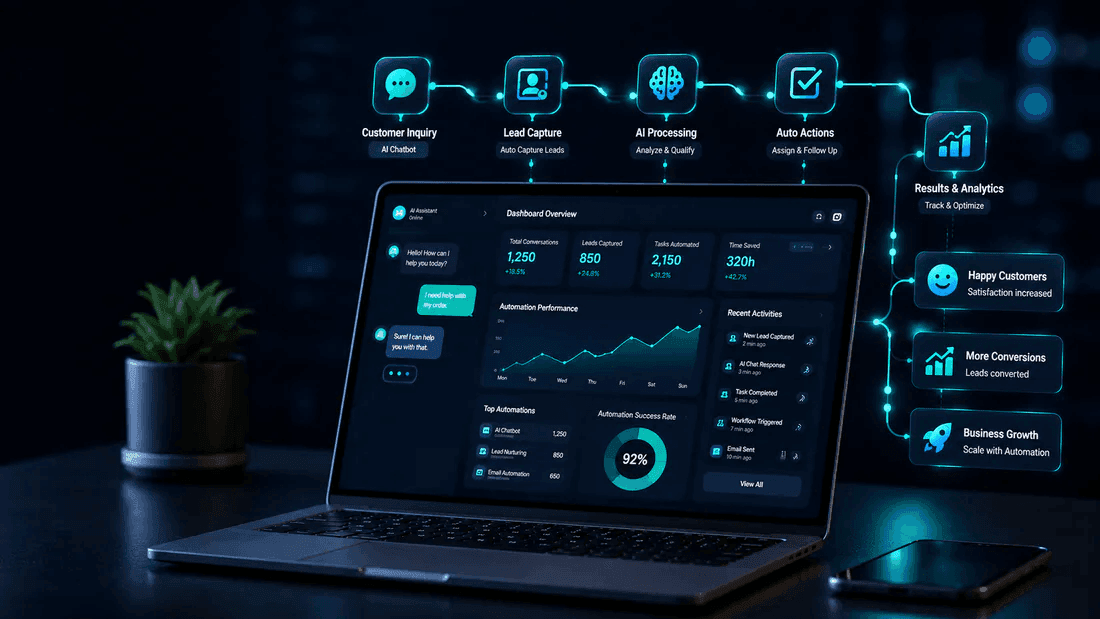
AI-powered automation systems that reduce manual work and improve response speed.
The AI conversation is full of hype and short on practical implementation. Most businesses don't need a general-purpose AI assistant. They need a specific solution to a specific problem — and they need it to actually work within their existing stack, with their existing data, in a way their team can understand, trust, and hand off to a new hire without a six-hour training session.
Weboraz builds AI automation that's grounded in that reality. We identify the exact workflows where AI genuinely saves time, reduces errors, or improves response quality — then build precisely that. Chatbots that understand your product. WhatsApp workflows that handle your lead qualification before business hours end. Document processing systems that replace hours of manual review. Measurable, connected, and built to improve over time.
The need for ai automation usually appears as business friction before it looks like a technology problem.
Early fixes are often reasonable. The problem is that they are rarely designed for the volume, coordination, or customer expectations a growing business eventually faces.
A shared method keeps decisions grounded in business context from the first conversation through continuous improvement.
Understand
Clarify
Strategize
Design
Build
Launch
Improve
The AI conversation is full of hype and short on practical implementation. Most businesses don't need a general-purpose AI assistant. They need a specific solution to a specific problem — and they need it to actually work within their existing stack, with their existing data, in a way their team can understand, trust, and hand off to a new hire without a six-hour training session. Weboraz builds AI automation that's grounded in that reality. We identify the exact workflows where AI genuinely saves time, reduces errors, or improves response quality — then build precisely that. Chatbots that understand your product. WhatsApp workflows that handle your lead qualification before business hours end. Document processing systems that replace hours of manual review. Measurable, connected, and built to improve over time.
What changes
Website and app chatbots trained on your products, services, policies, and FAQs — that answer questions accurately, qualify visitors, collect lead information, and route conversations to a human when the situation genuinely needs one. Not when it's just easier.
WhatsApp Business workflows for lead capture, appointment bookings, order confirmations, payment reminders, support triage, and ongoing customer communication — across one number that your whole team can manage, with AI handling the repetitive parts.
End-to-end automation flows that trigger on business events — new lead, form submission, status change, payment received, document uploaded — and route the right information to the right person or system without a human acting as the connector.
AI systems that capture, score, qualify, and categorise incoming leads based on your specific criteria before they enter your CRM — so your sales team opens every conversation already knowing who they're speaking to, what they need, and how serious they are.
Each part is included because it removes friction, improves confidence, or strengthens the result—not to inflate a feature list.
The value is visible in how customers respond, how teams operate, and how confidently the business can grow.
Before
Manual, repeated effort
After
A clearer and more efficient operating flow
Before
Disconnected customer moments
After
One coherent experience from interest to action
Before
Decisions based on assumptions
After
Useful signals that guide priorities
Before
A solution that strains with growth
After
A foundation designed to adapt with the business
Map the specific workflows, customer journeys, and repetitive tasks where AI can genuinely add value — not where it can just technically be applied to something that works fine without it.
Design the automation architecture: data sources, AI model selection, conversation flows, system prompts, guardrails, integration touchpoints, handoff rules, and the success metrics that prove it worked.
Build conversation design, workflow logic, edge case handling, and business process flows — tested against the kinds of questions and situations your real users will actually bring.
Develop AI agents, RAG pipelines, chatbot interfaces, automation triggers, API integrations, webhook handlers, and the admin tools for managing and monitoring the system.
Test response accuracy, edge case behaviour, hallucination prevention, handoff reliability, data security, system load performance, and end-to-end workflow reliability under realistic conditions.
Deploy to production with monitoring dashboards, team documentation, staff onboarding where needed, alerting for anomalies, and the kind of production-grade reliability a customer-facing system demands.
Review real conversation logs, identify where the AI underperforms or surprises people, refine prompts and knowledge bases, expand the automation to new use cases, and track the metrics that demonstrate business impact.
We choose the simplest dependable tools that fit the outcome, existing environment, and long-term ownership—not what happens to be fashionable.
AI Automation should reflect the pressures, expectations, and workflows of the business it serves.
Healthcare
The challenge
Complex journeys and sensitive information
How it helps
Create clearer access, dependable workflows, and experiences people can trust.
Startups
The challenge
Limited time, capital, and room for rework
How it helps
Validate the right priorities early and build a foundation that can evolve.
Professional Services
The challenge
Expertise is difficult to communicate and scale
How it helps
Turn knowledge into a credible, consistent client experience.
Retail
The challenge
Fragmented customer journeys and operational pressure
How it helps
Connect discovery, conversion, and fulfilment around one experience.
Logistics
The challenge
Disconnected teams, tools, and real-time decisions
How it helps
Improve visibility and make everyday operations easier to coordinate.
Practical answers to help you decide whether this is the right investment and what value should look like.
The most impactful applications we build are: handling customer enquiries outside business hours, qualifying and routing incoming leads before they reach a human, reducing support ticket volume through automated resolution, sending context-aware follow-up messages, and processing documents that currently require manual review. If a task is repetitive, rule-following, and takes time your team would rather spend on something higher-value — there is likely an AI solution worth building.
Yes. We use the official WhatsApp Business API to build automation flows for lead capture, appointment booking, order confirmations, payment reminders, support responses, and ongoing customer communication — managed across a single business number that your team can access and monitor.
Yes. We integrate AI flows with your existing website via chat widget or API endpoint, your CRM to create or update contact and deal records automatically, and your other business tools through webhooks and API connections — so AI works within your current stack rather than alongside it as a separate system.
Accuracy depends almost entirely on what the AI has access to and how well the system is designed. A well-built retrieval-augmented generation (RAG) system with quality source documentation will answer your specific questions reliably and acknowledge when it doesn't know something rather than guessing. We design for accuracy and honest fallback behaviour, not impressive-sounding responses.
Yes. We design AI systems with session-level data isolation, access controls, appropriate PII handling, conversation logging with consent mechanisms, and workflow boundaries that prevent data from one customer touching another's context. We can discuss specific compliance requirements for your industry during discovery.
Yes — and without a deliberate improvement process, it effectively gets worse relative to changing business needs and growing customer expectations. We review real conversation logs, identify gaps in accuracy or coverage, refine the system prompt and knowledge base, expand the automation to new workflows, and track the metrics that show whether the system is delivering business value.
Every successful technology project starts with understanding how your business works.