Work takes longer than it should
Repeated handoffs and avoidable steps consume time that should go into customers and growth.
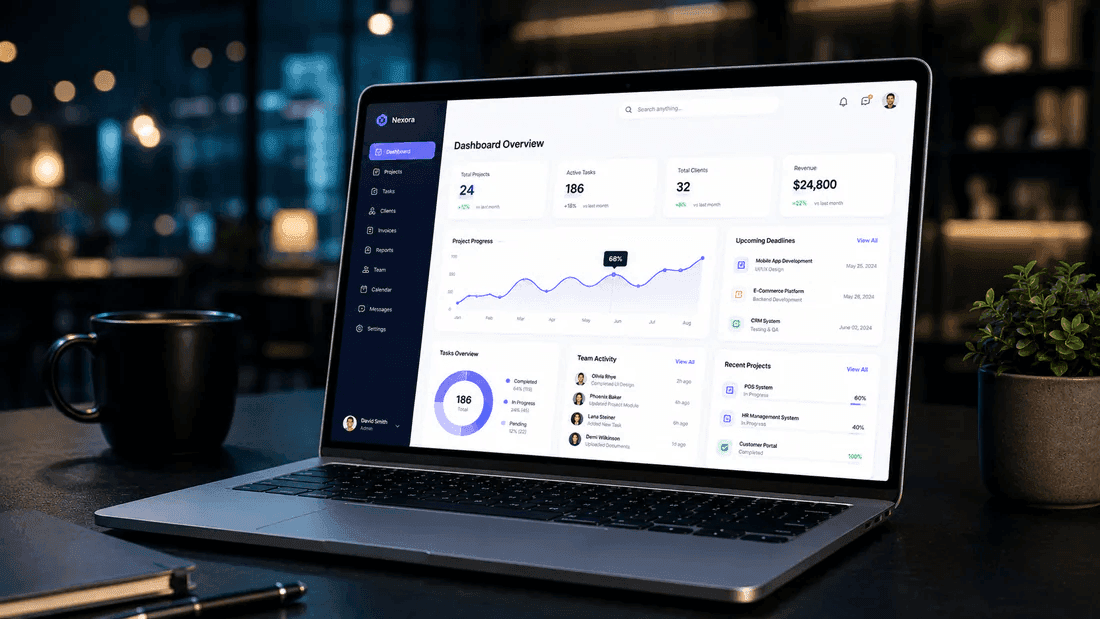
Your business is not generic. Your spreadsheets, workarounds, and 'we've always done it this way' processes are telling you something: the off-the-shelf tools weren't built for your workflow. Weboraz builds custom CRM systems, ERP platforms, business portals, SaaS applications, and operational software from the ground up — around your actual operations, your actual team, and your actual goals.
Designed around the outcome
Software systems built around your operations, teams, customers, and growth.
Most businesses reach a point where their tools stop working for them and they start working for their tools. A CRM that doesn't map to their sales process. An ERP that requires a consultant to do basic reporting. Five platforms with five logins that still require someone to copy-paste between spreadsheets on a Friday afternoon.
Custom software solves this not by adding more complexity, but by replacing the friction with something built around how your business actually operates. Weboraz designs and develops CRM systems, ERP platforms, business portals, SaaS applications, admin dashboards, and workflow software that is secure, scalable, and built for daily real-world usage — by real teams, under real operational pressure.
The need for custom software development usually appears as business friction before it looks like a technology problem.
Early fixes are often reasonable. The problem is that they are rarely designed for the volume, coordination, or customer expectations a growing business eventually faces.
A shared method keeps decisions grounded in business context from the first conversation through continuous improvement.
Understand
Clarify
Strategize
Design
Build
Launch
Improve
Most businesses reach a point where their tools stop working for them and they start working for their tools. A CRM that doesn't map to their sales process. An ERP that requires a consultant to do basic reporting. Five platforms with five logins that still require someone to copy-paste between spreadsheets on a Friday afternoon. Custom software solves this not by adding more complexity, but by replacing the friction with something built around how your business actually operates. Weboraz designs and develops CRM systems, ERP platforms, business portals, SaaS applications, admin dashboards, and workflow software that is secure, scalable, and built for daily real-world usage — by real teams, under real operational pressure.
What changes
Custom CRM platforms that map exactly to your sales process — lead capture, pipeline tracking, follow-up scheduling, client records, communication history, and reporting that your team actually uses instead of avoids at month-end.
End-to-end business management systems covering inventory, procurement, HR workflows, approval chains, financial reporting, and operational visibility — built around your processes, not a consultant's idea of industry best practice.
Internal control panels for managing users, transactions, content, inventory, support tickets, approvals, reports, and everything else in your operation that needs a human decision with full data context.
Secure, role-based portals for employees, clients, vendors, or partners — document sharing, project tracking, status updates, approvals, and everything that currently happens over email and WhatsApp, done properly.
Each part is included because it removes friction, improves confidence, or strengthens the result—not to inflate a feature list.
The value is visible in how customers respond, how teams operate, and how confidently the business can grow.
Before
Manual, repeated effort
After
A clearer and more efficient operating flow
Before
Disconnected customer moments
After
One coherent experience from interest to action
Before
Decisions based on assumptions
After
Useful signals that guide priorities
Before
A solution that strains with growth
After
A foundation designed to adapt with the business
Audit your current workflows, tools, pain points, data flows, user roles, and business requirements — because software that doesn't understand the problem it's solving cannot solve it.
Design the full system architecture: database models, user permission structures, module boundaries, API contracts, integration points, and a delivery plan that shows working software early — not just at the end.
Build the interfaces your team will use every day — dashboards, forms, data tables, approval flows, search, filters, and the UX that makes powerful software feel like it was always supposed to be this way.
Develop the business logic, API layer, database structures, workflow automations, integrations, and backend systems with clean, documented, maintainable code that your team can evolve.
Test every permission boundary, every workflow path, every edge case, and every data transformation — because finding a bug in testing costs hours, and finding it in production costs something much more significant.
Deploy to production infrastructure with monitoring, automated backups, access control setup, audit logging, and a go-live plan that doesn't involve hoping for the best.
Support the system long-term — new features as the business evolves, performance improvements as usage grows, and technical guidance as the organisation's priorities change.
We choose the simplest dependable tools that fit the outcome, existing environment, and long-term ownership—not what happens to be fashionable.
Custom Software Development should reflect the pressures, expectations, and workflows of the business it serves.
Healthcare
The challenge
Complex journeys and sensitive information
How it helps
Create clearer access, dependable workflows, and experiences people can trust.
Startups
The challenge
Limited time, capital, and room for rework
How it helps
Validate the right priorities early and build a foundation that can evolve.
Professional Services
The challenge
Expertise is difficult to communicate and scale
How it helps
Turn knowledge into a credible, consistent client experience.
Retail
The challenge
Fragmented customer journeys and operational pressure
How it helps
Connect discovery, conversion, and fulfilment around one experience.
Logistics
The challenge
Disconnected teams, tools, and real-time decisions
How it helps
Improve visibility and make everyday operations easier to coordinate.
Practical answers to help you decide whether this is the right investment and what value should look like.
Custom software is built specifically for your business — your workflows, your users, your data, and your operational requirements — rather than asking your team to adapt to the constraints of an off-the-shelf product. It costs more to build upfront and almost always saves more in the long run.
Yes, and we do it regularly. Spreadsheets are a symptom of software that hasn't kept up with the business. We map your current process, identify what needs to be digitised or automated, and replace it with something your team will genuinely prefer using — not something they tolerate.
Yes. We build custom CRM systems tailored to your actual sales process and ERP platforms built around your specific operational workflows — not a generic suite where 60% of the features are things your team will never open.
A focused internal tool or single CRM module can be delivered in 6–10 weeks. A full ERP or multi-module business platform takes several months depending on complexity. We give realistic timelines after we understand what's being built — not estimates designed to win the engagement before discovery starts.
Yes. We connect custom software with payment platforms, accounting tools, email services, WhatsApp, document storage, analytics, government portals, and any system with a usable API. Most integration work is straightforward once the architecture is designed correctly.
Scalability is a design decision made at the start, not a retrofit added later when things are already struggling. We build with modular architecture from day one so new users, departments, product lines, and integrations can be added without reengineering what's already working.
Every successful technology project starts with understanding how your business works.