
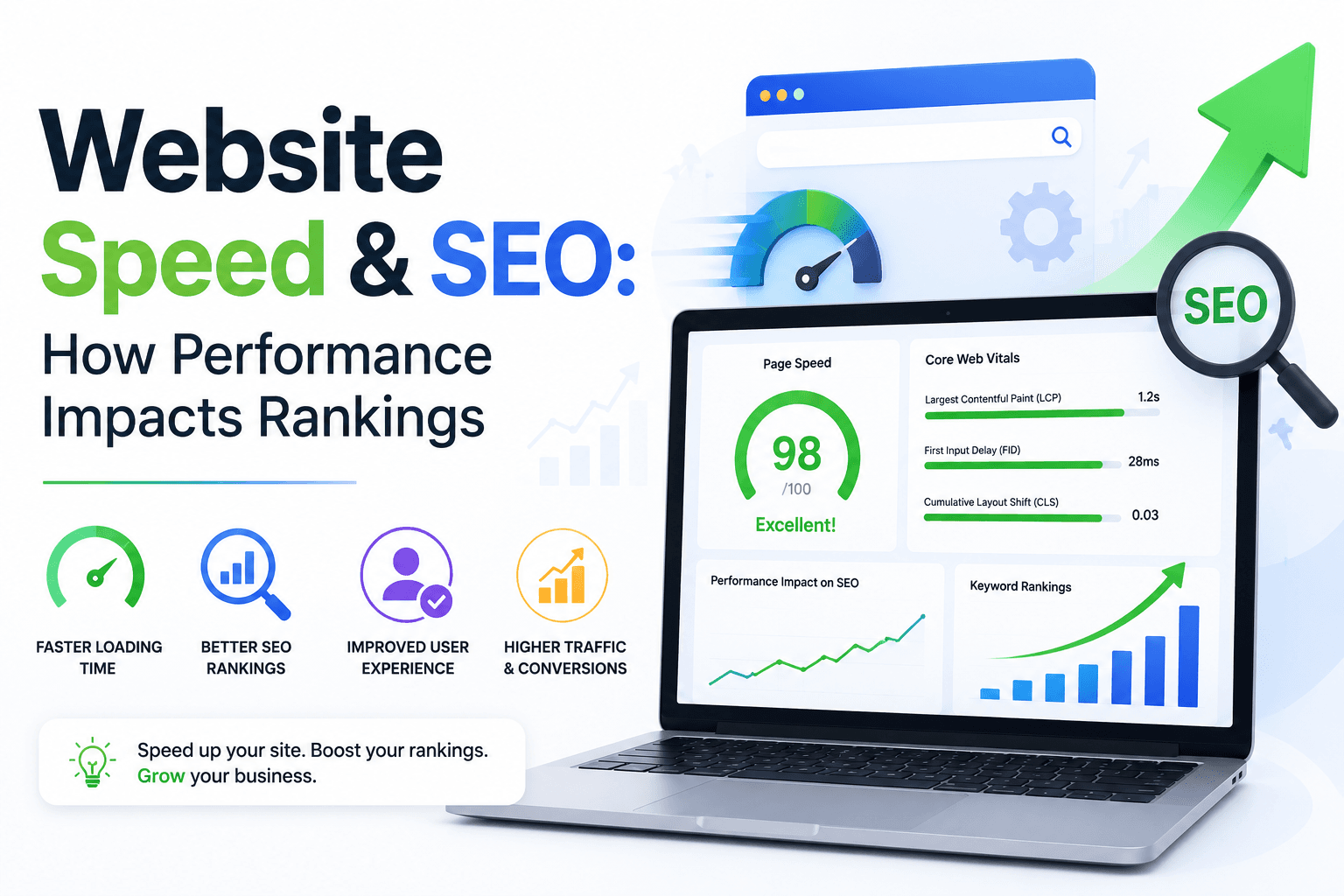
Ever clicked away from a website before it even finished loading? You're not alone - and neither are your visitors. What most business owners don't realize is that Google notices that exact behaviour too. Website speed isn't just a user experience detail anymore; it's a direct ranking factor. This blog breaks down why performance affects your Google ranking, what Google actually measures, and how to know if your site is quietly losing visibility because of it.
Why Google Cares About Page Speed
Google's core mission is to deliver the best possible result for a search - and a slow, frustrating page works against that goal, no matter how good the content is. Since the rollout of Core Web Vitals as a ranking signal, speed and user experience are measured directly, not just implied.
- Largest Contentful Paint (LCP): how quickly the main content loads
- Interaction to Next Paint (INP): how responsive the page feels when someone interacts with it
- Cumulative Layout Shift (CLS): how much the page visually jumps around while loading
Sites that perform poorly across these metrics tend to rank lower, even when their content is strong.
The Direct Link Between Speed and Bounce Rate
Slow pages don't just annoy visitors - they push them straight back to the search results. When someone bounces quickly after landing on your page, it signals to Google that the result didn't satisfy the search, which can quietly erode rankings over time.
Think of it from Google's perspective: if two businesses offer similar content, but one loads instantly and the other drags, which one is more likely to keep the visitor around? Speed becomes a tiebreaker even between otherwise equal competitors.
Mobile Speed Matters Even More
Most searches now happen on mobile devices, often on inconsistent networks. A site that loads acceptably on a fast office Wi-Fi connection can feel painfully slow on a phone with average mobile data.
Google evaluates your site primarily through mobile-first indexing, meaning your mobile performance - not your desktop version - is what largely determines your ranking.
Common Culprits Behind a Slow Website
Performance issues rarely come from one single cause. It's usually a combination of small inefficiencies that add up:
- Unoptimized or oversized images
- Too many third-party scripts (chat widgets, trackers, ad tags)
- Outdated hosting or server response delays
- Bloated code from years of plugins and patches layered on top of each other
- Render-blocking resources that delay the page from becoming interactive
Identifying which of these apply to your site usually requires more than a quick glance — it often means a proper technical audit.
How Speed Issues Compound Over Time
A website that was fast at launch doesn't necessarily stay that way. As businesses add features, integrations, images, and tracking tools over the years, performance tends to quietly degrade - often without anyone noticing until rankings start slipping.
This is a common turning point where businesses realize they need more than small fixes - they need the site rebuilt on a stronger technical foundation through proper web development, rather than another round of patchwork optimization.
Speed as Part of a Bigger Technical SEO Picture
Page speed doesn't work in isolation - it's one piece of technical SEO alongside site structure, mobile responsiveness, and clean code. A site can have excellent content and still underperform in search if the technical foundation beneath it is weak.
This is often where custom software development makes a measurable difference: a site built with performance in mind from the start avoids the slow accumulation of speed issues that plague sites patched together over time.
When Automation Can Help Performance Indirectly
While automation doesn't directly fix load times, AI automation can reduce the number of heavy third-party scripts and manual processes running on your site - like replacing multiple tracking or chat tools with a single streamlined system - which can meaningfully lighten the load your site carries.
Does website speed really affect Google rankings?+
Yes. Google has confirmed that Core Web Vitals — which measure loading speed, interactivity, and visual stability - are used as part of its ranking signals, particularly for mobile search results.
How fast should my website load?+
There's no single fixed number that guarantees rankings, but generally, the faster your key content loads and becomes interactive, the better both users and Google respond to it.
Can a slow website hurt my rankings even with great content?+
Yes. Strong content can still underperform in search if visitors bounce before they engage with it, or if technical issues prevent Google from crawling and rendering the page efficiently.
What's the fastest way to know if my site has a speed problem?+
A technical audit is the most reliable way - it identifies exactly which elements (images, scripts, hosting, code) are slowing your site down, rather than guessing.
Is a full website rebuild necessary to fix speed issues?+
Not always. Some issues can be fixed with targeted optimization, but if the slowdown comes from outdated architecture or years of layered plugins, a rebuild is often more effective long-term than continuous patching.
Is Your Website's Speed Costing You Rankings You Don't Know You're Losing?
Most businesses don't find out their site has a performance problem until traffic quietly starts declining. At Weboraz, we don't just glance at load times - we dig into the actual technical reasons your site is slow, from code to hosting to third-party bloat, because we start with the problem, not a generic checklist. With a hybrid US-India team across web development, software development, and AI automation, we build sites engineered to perform, not just look good.
Need help applying this?
Our team can turn the ideas in this article into a clear plan and a polished build.
Book a Consultation