As businesses grow, the software decisions that seemed simple early on start carrying much higher stakes - and the choice between enterprise software and SaaS is one of the clearest examples. Both are built to support growing organizations, but they take fundamentally different approaches to get there, with real tradeoffs in cost, control, and flexibility. This blog breaks down how enterprise software and SaaS actually compare, so you can make the right choice as your business scales.
What SaaS Actually Means
SaaS, or Software as a Service, refers to cloud-based software accessed through a subscription, hosted and maintained entirely by the provider. Users simply log in and use the tool, without managing infrastructure or installations themselves.
SaaS tends to work well for:
- Standardized business functions like CRM, accounting, or project management
- Businesses that want to get up and running quickly
- Organizations without a large internal technical team to manage software infrastructure
What Enterprise Software Actually Means
Enterprise software typically refers to more extensive, often custom-built systems designed specifically around an organization's complex operations, data, and workflows. Unlike SaaS, it may be deployed on private infrastructure, deeply integrated with other internal systems, and tailored precisely to how the business functions.
Enterprise software tends to make sense for:
- Organizations with complex, unique operational requirements
- Businesses needing deep integration across multiple internal systems
- Companies with specific security, compliance, or data control requirements that standard SaaS tools can't fully meet
The Core Tradeoff: Standardization vs Customization
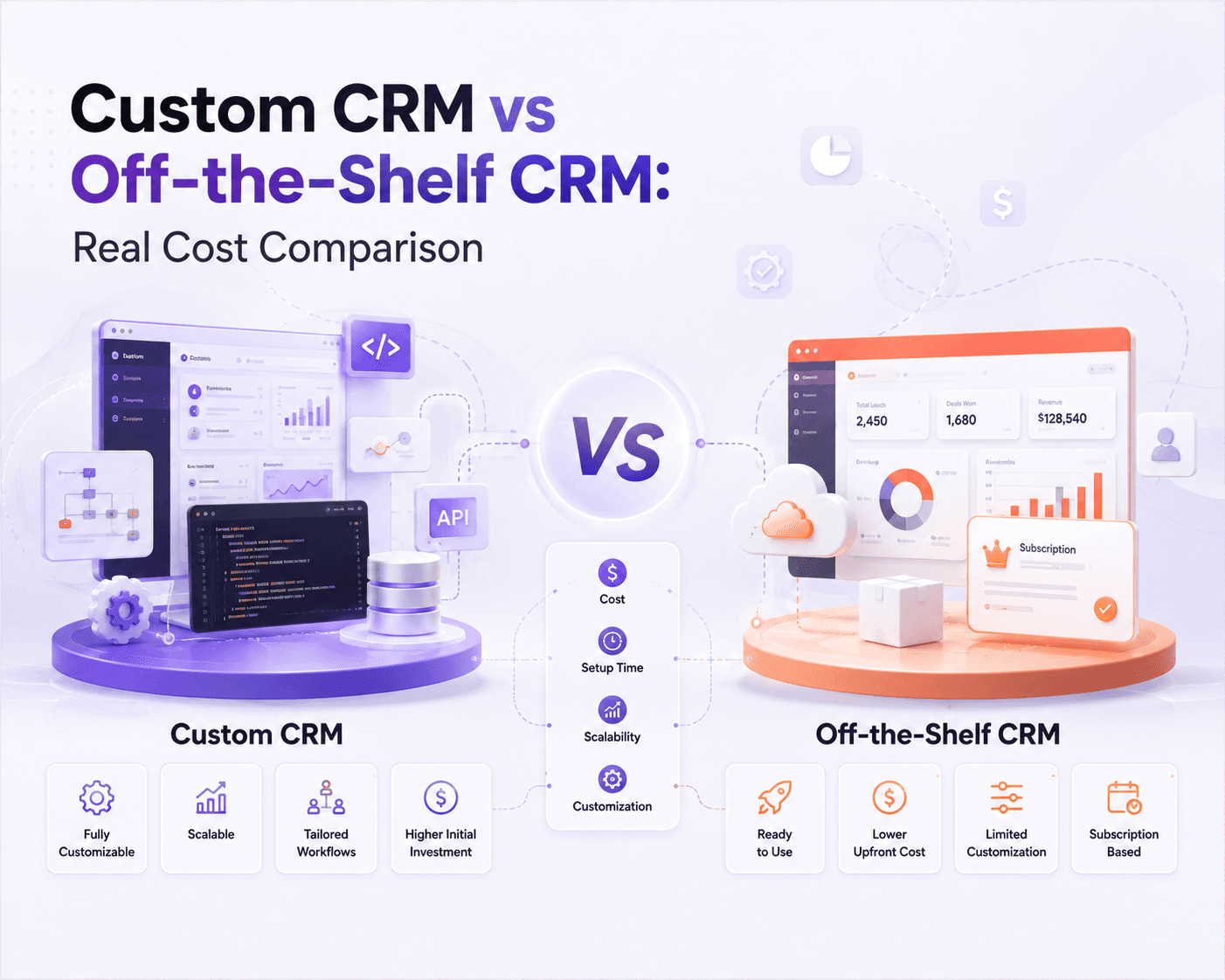
SaaS delivers speed and simplicity by standardizing functionality across all customers - everyone gets essentially the same tool, with limited customization. Enterprise software delivers deep customization by being built specifically around one organization's needs, at the cost of a longer development timeline and higher upfront investment.
Neither approach is universally better - the right choice depends on how standard or unique your operational needs actually are.
How Scale Changes the Calculation
For a smaller or early-stage business, SaaS tools often make complete sense — the standardized functionality covers most needs, and the low upfront cost fits tighter budgets. As a business scales, though, several things tend to shift:
- Per-user SaaS pricing can become significantly more expensive as headcount grows
- Standardized tools increasingly struggle to accommodate more complex, unique workflows
- Data silos across multiple SaaS tools become harder to manage as operations grow more complex
- Security, compliance, or data control requirements often become more stringent
This is often the point where businesses start seriously evaluating custom software development as an alternative to continuing to stack more SaaS subscriptions.
Cost Considerations Beyond the Sticker Price
SaaS pricing looks simpler upfront - a predictable subscription fee. But at scale, this can become misleading:
- Per-user fees multiply significantly as teams grow
- Add-on features or higher tiers often become necessary as needs increase
- The cost of working around limitations, or maintaining multiple disconnected tools, adds up over time
Enterprise software requires a larger upfront investment, but doesn't carry the same recurring per-user cost structure, often making it more cost-effective at larger scale despite the higher initial cost.
Security and Compliance Considerations
Larger organizations, or those in regulated industries, often have security and compliance requirements that standard SaaS tools weren't built to fully address. Enterprise software allows for infrastructure, data handling, and security measures built precisely around specific regulatory or organizational requirements, offering a level of control that off-the-shelf SaaS typically can't match.
Integration Complexity at Scale
As businesses grow, the number of systems that need to work together tends to increase significantly. SaaS tools vary widely in how well they integrate with each other, sometimes requiring additional middleware or manual processes to bridge gaps. Enterprise software can be architected with integration as a core design principle from the start, reducing this friction as the organization scales.
A Hybrid Approach Is Common at Scale
Many larger organizations don't choose one extreme exclusively - they use SaaS tools for standard, non-differentiating functions while investing in enterprise software development for the core systems that genuinely define how their business operates differently from competitors.
Where AI Automation Fits Into This Decision
Both SaaS and enterprise software can incorporate AI automation, but the depth of customization differs significantly - SaaS tools typically offer generic automation features, while enterprise software can build automation precisely around the organization's specific processes and data.
Frequently Asked Questions
Is enterprise software always better than SaaS for a growing business?
Not necessarily. It depends on how standard or unique your operational needs are — many growing businesses continue using SaaS effectively for standard functions even as they scale.
At what point should a business consider enterprise software over SaaS?
Common signals include rising per-user SaaS costs, workflows that no longer fit standardized tools, or increasing security and compliance requirements that SaaS can't fully address.
Is enterprise software more expensive than SaaS overall?
Upfront, generally yes. But at larger scale, enterprise software's lack of recurring per-user fees can make it more cost-effective long-term compared to multiple growing SaaS subscriptions.
Can a business use both SaaS and enterprise software together?
Yes, and many do. A common approach uses SaaS for standard functions while investing in enterprise software for the core systems unique to how the business operates.
Does enterprise software take longer to implement than SaaS?
Generally yes, since it involves custom development, while SaaS tools are typically ready to use almost immediately after subscribing.
Not Sure Which Path Fits Your Scale?
The SaaS versus enterprise software decision isn't about which is "better" - it's about what actually fits your operations as you grow. At Weboraz, we help you evaluate that honestly, based on your real scale and complexity, not a default recommendation. With a hybrid US-India team spanning software development, web development, and AI automation, we build solutions designed to scale with your business, whichever path fits.
Get a free scaling strategy consultation from Weboraz and find out which approach makes sense for you.