

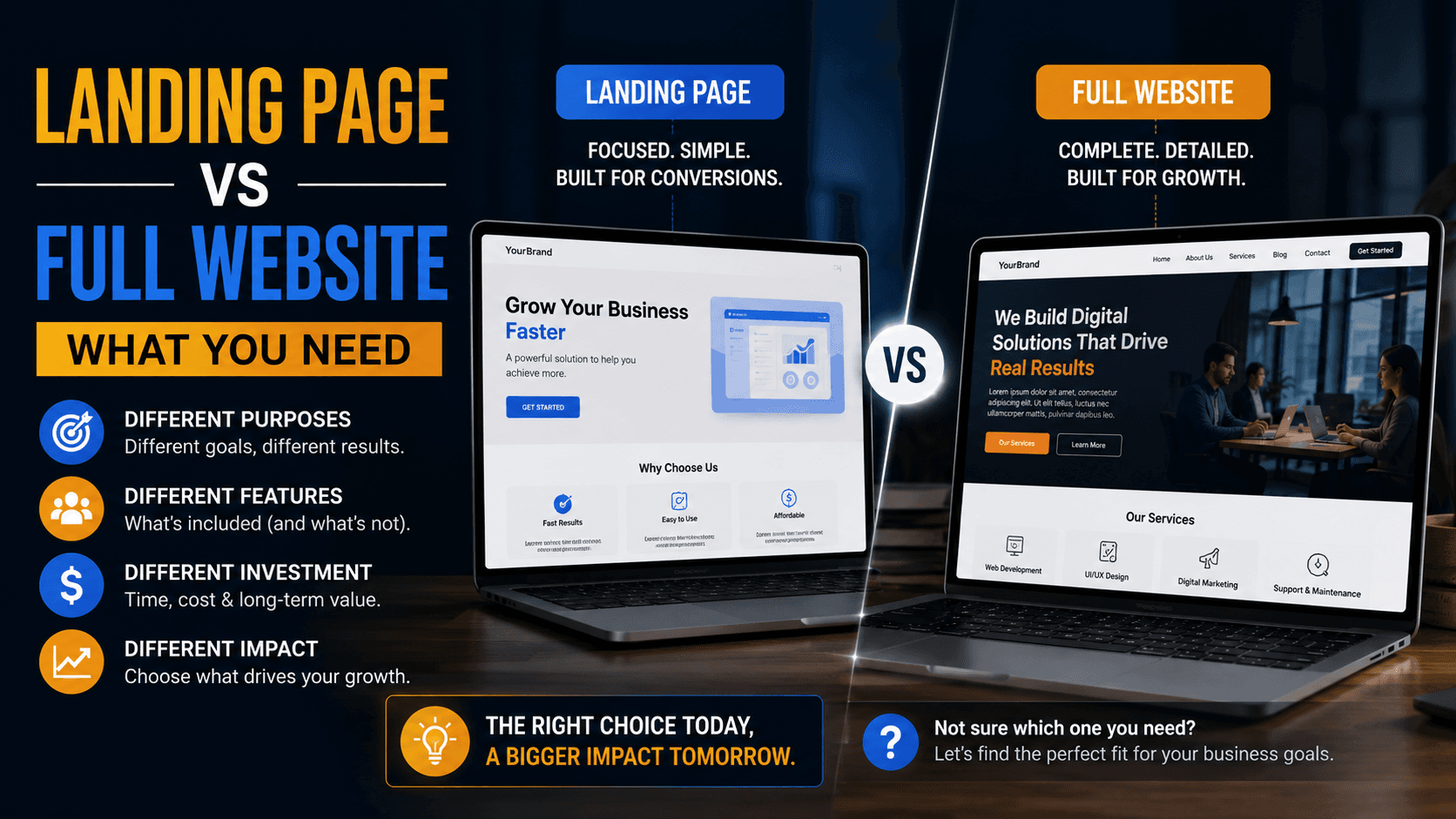
Sending paid traffic or campaign clicks to the wrong destination is one of the most common - and most avoidable - ways businesses quietly waste marketing budget. A landing page and a full website solve very different problems, and using one where the other belongs often shows up directly in a lower conversion rate. This blog breaks down when your campaign actually needs a dedicated landing page versus your full website, so your traffic lands somewhere built to convert it.
What a Landing Page Is Actually Built For
A landing page is a focused, standalone page designed around a single goal - usually driving one specific action, like a signup, a purchase, or a form submission. It intentionally strips away navigation and distractions so visitors have one clear path forward.
Landing pages work well for:
- Paid ad campaigns where every click has a cost attached
- Promoting a specific offer, product launch, or event
- A/B testing messaging or offers without touching your main site
Because a landing page has one job, it's built entirely around conversion, not exploration.
What a Full Website Is Actually Built For
A full website serves a broader purpose - informing visitors, building trust, and supporting multiple types of visitor intent across many pages. Unlike a landing page, it's designed for exploration, not a single forced action.
A full website makes more sense when:
- Visitors need to learn about your business more broadly before deciding
- You offer multiple products or services that don't fit a single narrow message
- Long-term SEO and organic discovery matter, not just a single campaign
Why Sending Campaign Traffic to a Full Website Often Underperforms
When someone clicks a targeted ad expecting one specific offer, landing on a full website with a general homepage and multiple navigation options often creates friction instead of clarity. Visitors have to hunt for what they came for, and every extra click or distraction reduces the likelihood they complete the action you actually wanted.
This mismatch between campaign intent and destination page is one of the most common, fixable reasons paid campaigns underperform.
Why a Landing Page Alone Isn't Always Enough
Landing pages aren't a replacement for a full website - they work best as a focused entry point that exists alongside your broader site, not instead of it. If a visitor isn't ready to convert immediately, they'll often want to explore more about your business, which a single-purpose landing page isn't built to support.
Matching the Page Type to the Campaign Goal
The right choice really comes down to what you're asking the visitor to do:
- Running a specific offer or promotion → landing page
- Launching a paid ad campaign with a single conversion goal → landing page
- Building long-term brand visibility and organic traffic → full website
- Supporting a visitor through a longer research and decision process → full website
- Testing a new message or offer quickly → landing page, since it's easier to build and iterate without touching your main site
Design Differences That Actually Matter
Beyond structure, landing pages and full websites are typically designed differently:
- Landing pages minimize navigation and distractions, often removing menus and links away from the desired action entirely
- Full websites prioritize discoverability, encouraging visitors to explore multiple pages
- Landing pages usually feature one clear, repeated call-to-action, while full websites support multiple pathways depending on visitor intent
Why the Underlying Build Still Matters for Either Option
Whether it's a landing page or a full website, performance depends heavily on the underlying web development — page speed, mobile responsiveness, and clean structure affect conversion rates regardless of which format you choose. A poorly built landing page can underperform just as easily as a poorly built website.
Where Automation Can Strengthen Either Approach
Both landing pages and full websites can benefit from AI automation, such as automated follow-up messages after a form submission or smart routing of leads captured through a campaign, helping convert initial interest into an actual next step without manual follow-up.
Frequently Asked Questions
Can I use my homepage instead of a dedicated landing page for a campaign?
You can, but it often performs worse, since homepages include distractions and multiple pathways that dilute focus away from the specific action you want visitors to take.
Do I need both a landing page and a full website?
Many businesses do. Landing pages work well as focused entry points for specific campaigns, while a full website supports broader visibility and longer-term visitor journeys.
Are landing pages only useful for paid advertising?
No, though that's a common use case. Landing pages also work well for product launches, events, or any scenario where you want a single, clear conversion goal.
Which is more expensive to build, a landing page or a full website?
Landing pages are generally less expensive and faster to build, since they involve a single focused page rather than the multiple pages and navigation structure of a full website.
How do I know if my campaign needs a landing page or my existing website is enough?
If the campaign has one specific, narrow goal, a dedicated landing page usually performs better. If it's meant to support broader exploration of your business, your full website may already be well suited.
Not Sure Which One Your Campaign Needs?
Sending traffic to the wrong page type quietly costs businesses conversions every day, often without anyone realizing why performance is lower than expected. At Weboraz, we help you match the right page type to your actual campaign goal, rather than defaulting to whatever's easiest to build. With a hybrid US-India team spanning web development, software development, and AI automation, we build landing pages and websites designed to convert, not just exist.
Get a free campaign strategy consultation from Weboraz and find out what your next campaign actually needs.
Frequently asked questions
You can, but it often performs worse, since homepages include distractions and multiple pathways that dilute focus away from the specific action you want visitors to take.
Many businesses do. Landing pages work well as focused entry points for specific campaigns, while a full website supports broader visibility and longer-term visitor journeys.
No, though that's a common use case. Landing pages also work well for product launches, events, or any scenario where you want a single, clear conversion goal.
Landing pages are generally less expensive and faster to build, since they involve a single focused page rather than the multiple pages and navigation structure of a full website.
If the campaign has one specific, narrow goal, a dedicated landing page usually performs better. If it's meant to support broader exploration of your business, your full website may already be well suited.
Related Articles


Need help applying this?
Our team can turn the ideas in this article into a clear plan and a polished build.
Contact Us