

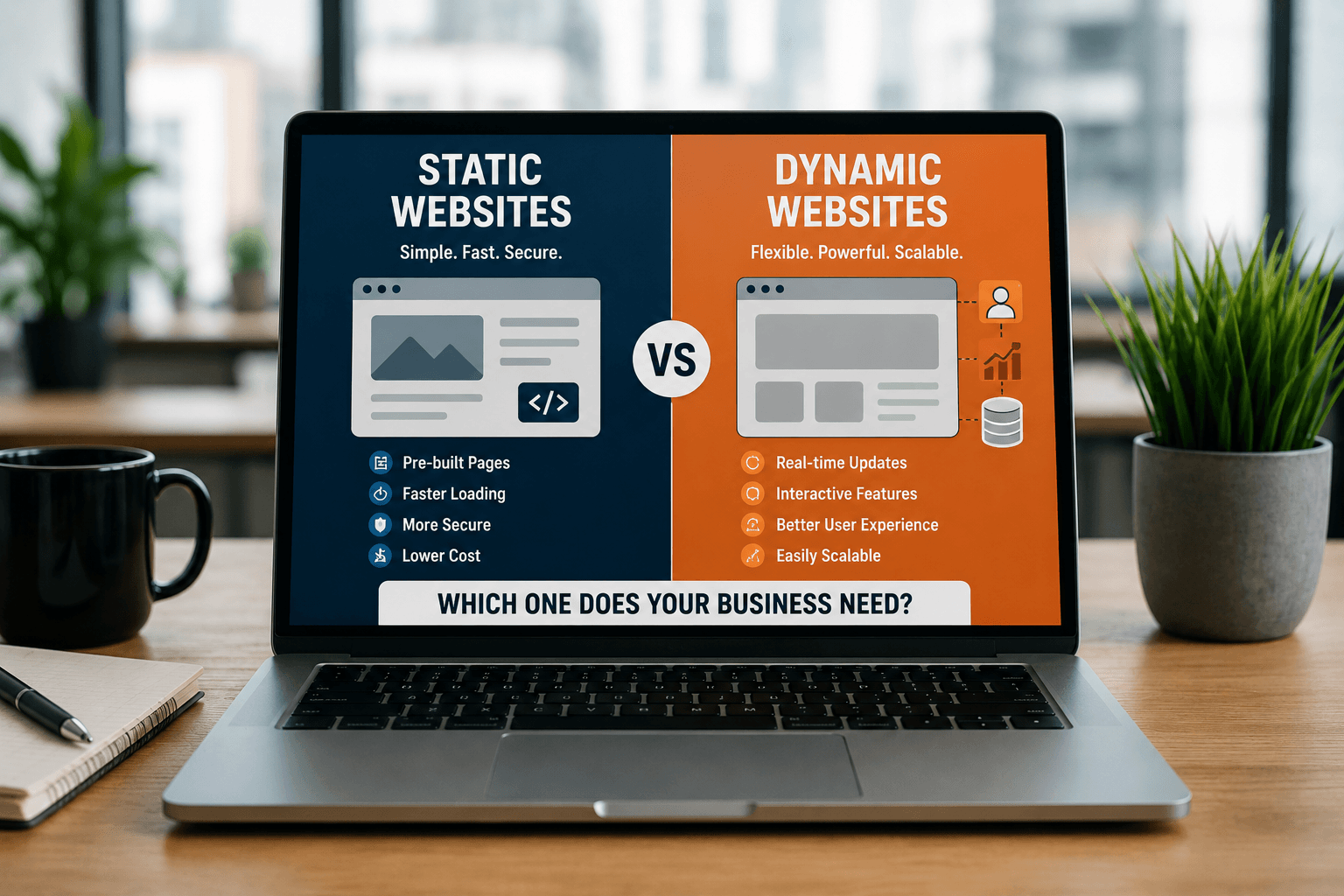
"Static" and "dynamic" get thrown around a lot in early website conversations, but many business owners aren't entirely sure what the terms actually mean for their specific project or which one makes more sense for their goals. Picking the wrong type can mean overpaying for complexity you don't need, or underbuilding something your business will quickly outgrow. This blog breaks down the real difference between static and dynamic websites, so you can decide which one actually fits your business.
What a Static Website Actually Is
A static website displays the same fixed content to every visitor, every time. The pages are pre-built and don't change unless someone manually updates the code or content behind the scenes.
Static websites tend to work well for:
- Simple business websites focused on information, not interaction
- Portfolios, landing pages, or brochure-style sites
- Businesses that don't need frequent content updates or user accounts
Because there's less complexity behind the scenes, static sites are often faster to load and simpler to maintain.
What a Dynamic Website Actually Is
A dynamic website generates content in real time based on the user, their actions, or data pulled from a database - think personalized dashboards, search functionality, or content that changes depending on who's logged in.
Dynamic websites tend to make sense when your business needs:
- User accounts, logins, or personalized experiences
- Frequently updated content, like a blog or product catalog
- Interactive features such as search, filtering, or booking systems
The tradeoff is that dynamic websites generally require more development work and ongoing technical maintenance than static sites.
Comparing the Two at a Glance
Static Website
- Content: Fixed, same for every visitor
- Best for: Simple informational sites, portfolios, landing pages
- Load speed: Generally faster
- Maintenance: Lower, but manual updates required for changes
Dynamic Website
- Content: Changes based on user, data, or interaction
- Best for: E-commerce, member portals, content-heavy or interactive sites
- Load speed: Can be fast, but depends on backend efficiency
- Maintenance: Higher, but content updates don't require manual code changes
Why Speed and Simplicity Favor Static Sites
Since static websites don't need to process requests or pull data in real time, they tend to load faster and are less prone to backend issues. This makes them a strong choice for businesses whose primary goal is simply presenting information clearly and reliably.
Why Interactivity and Personalization Favor Dynamic Sites
If your business depends on user accounts, real-time data, or content that needs to update frequently without manual intervention, a dynamic website becomes less of a preference and more of a necessity. Trying to force this functionality onto a static site usually results in a clunky, limited experience.
How to Decide What Your Business Actually Needs
Rather than starting with the technical labels, it helps to start with a simpler question: does your website need to do something different for each visitor, or show the same thing to everyone?
- If it's mostly informational and doesn't change often → a static website is likely sufficient
- If it involves accounts, personalization, or frequently changing content → a dynamic website is the better fit
- If you're unsure how much your content needs will grow → it's worth planning with future flexibility in mind, not just today's needs
Why the Underlying Build Still Matters Either Way
Regardless of which type fits your business, the quality of the underlying web development determines how well the site performs, scales, and holds up over time. A poorly built static site can still feel clunky, and a poorly built dynamic site can be slow and unreliable — the category is only part of the decision.
Where Automation Can Fit Into Either Type
Even a simple static site can incorporate elements of AI automation, such as an embedded chat widget for basic inquiries, while dynamic sites can go further with automated workflows tied directly into user accounts or data. The right level of automation depends less on static versus dynamic, and more on what your business actually needs it to do.
Frequently Asked Questions
Can a static website be upgraded to dynamic later?
Yes, though it usually requires meaningful rebuilding rather than a simple upgrade, which is why it helps to think ahead about future needs before choosing.
Is a dynamic website always better than a static one?
Not necessarily. If your business doesn't need personalization, accounts, or frequently changing content, a static website can be simpler, faster, and more cost-effective.
Which is cheaper to build, a static or dynamic website?
Static websites are generally less expensive to build initially, since they don't require the backend development, databases, or ongoing technical maintenance that dynamic sites need.
Do I need a dynamic website if I want a blog on my site?
Usually yes, since blogs typically require content to be added and updated without manual code changes - a core characteristic of dynamic websites.
How do I know which type is right for my specific business?
The clearest way is to map out what you need your website to actually do - informational and unchanging points toward static, while interactive and personalized points toward dynamic.
Still Not Sure Which One Fits Your Business?
Static or dynamic isn't a trend decision - it's a business decision that should follow what your website actually needs to do. At Weboraz, we help you make that call honestly, based on your goals, not a default recommendation. With a hybrid US-India team spanning web development, software development, and AI automation, we build exactly the type of website your business needs - nothing more, nothing less.
Get a free website strategy consultation from Weboraz and find out which type actually fits your business.
Frequently asked questions
Yes, though it usually requires meaningful rebuilding rather than a simple upgrade, which is why it helps to think ahead about future needs before choosing
Not necessarily. If your business doesn't need personalization, accounts, or frequently changing content, a static website can be simpler, faster, and more cost-effective.
Static websites are generally less expensive to build initially, since they don't require the backend development, databases, or ongoing technical maintenance that dynamic sites need.
Usually yes, since blogs typically require content to be added and updated without manual code changes - a core characteristic of dynamic websites.
The clearest way is to map out what you need your website to actually do — informational and unchanging points toward static, while interactive and personalized points toward dynamic.
Related Articles


Need help applying this?
Our team can turn the ideas in this article into a clear plan and a polished build.
Contact Us