

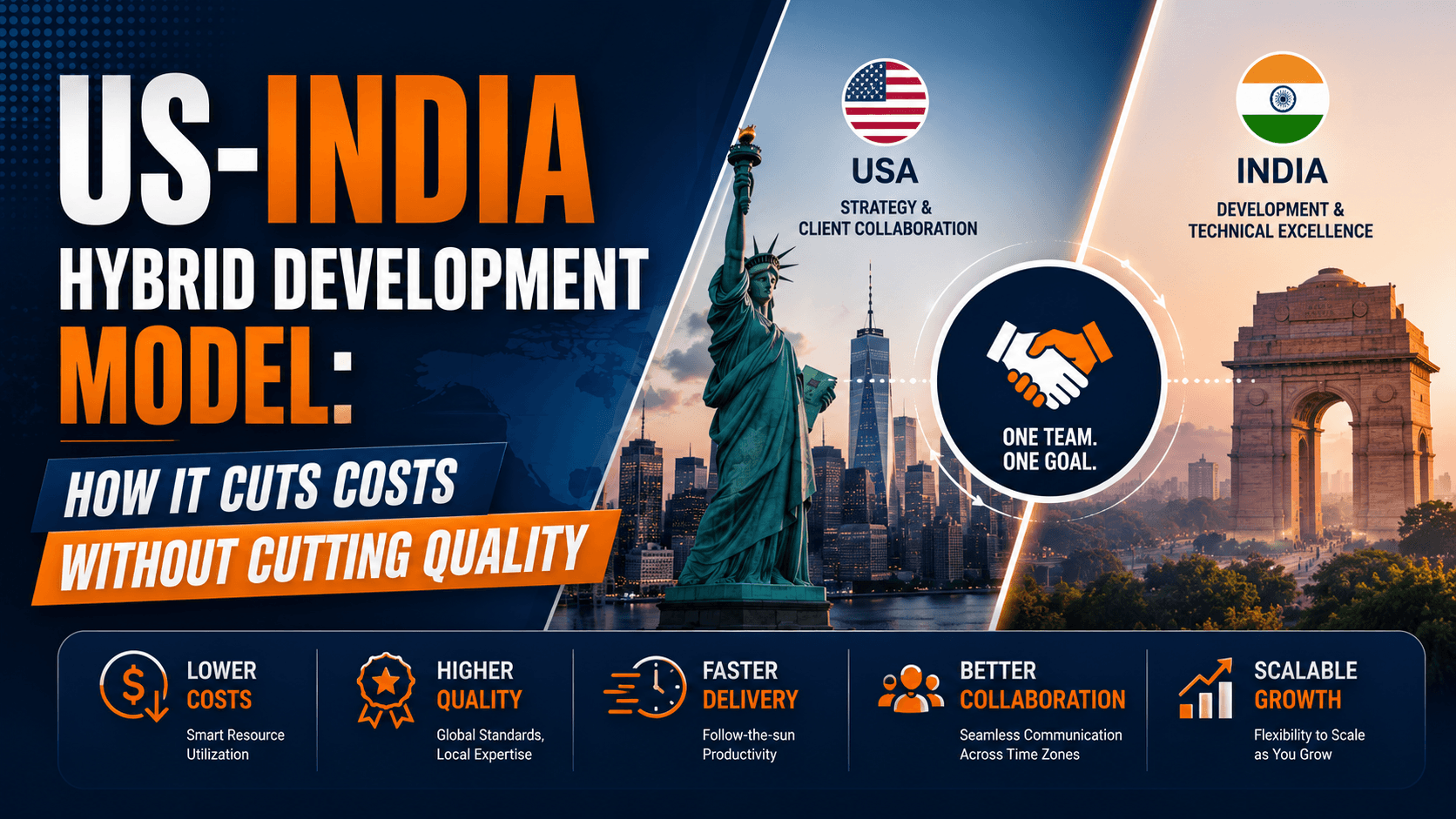
"Cheaper development" and "high quality" rarely get used in the same sentence - and for good reason, since cutting corners on cost usually does mean cutting corners on quality somewhere else. But a well-structured US-India hybrid development model is one of the few genuine exceptions, combining the cost advantages of a global team with the oversight and communication standards businesses expect. This blog explains how the hybrid model actually works, and why it's different from the outsourcing risks many businesses associate with the idea.
Why "Hybrid" Is Different From "Outsourced"
Traditional outsourcing often means handing a project to an external, disconnected team with limited visibility and inconsistent communication. A hybrid model is structured differently - it's one integrated team spanning both countries, working together under shared processes and standards, not a separate vendor operating at arm's length.
This distinction matters because most of the horror stories associated with "cheap offshore development" come from the outsourcing model, not the hybrid one.
How the Cost Advantage Actually Works
Development costs vary significantly by region due to differences in cost of living and market rates - not because of differences in skill or work quality. A hybrid model takes advantage of this by structuring teams across both countries, allowing businesses to access strong technical talent at a more efficient overall cost than a single-region team of equivalent size.
Importantly, this isn't about paying less for less - it's about the same quality of work costing less to deliver when structured this way.
Round-the-Clock Development Without Round-the-Clock Overtime
One practical advantage of a US-India hybrid model is time zone coverage. Work can continue across the day without requiring any single team to work unreasonable hours - one side hands off progress as the other begins, creating a more continuous development cycle than a single-location team can typically offer.
This often translates into faster turnaround on certain types of work, without relying on rushed or unsustainable overtime from any one group.
Maintaining Quality Through Shared Standards, Not Separate Teams
The businesses that see the best results from a hybrid model treat it as one team with shared processes, not two separate groups working in isolation. This typically includes:
- Consistent coding standards and review processes across both locations
- Shared project management and communication tools, not fragmented systems
- Senior oversight involved throughout, not just at the beginning and end of a project
This structure is what actually protects quality - the savings come from where the work is done, not from lowering the bar for how it's done.
Communication Is Often the Deciding Factor
Businesses hesitant about hybrid or global teams are usually worried about communication breakdowns — and that concern is valid when a model lacks structure. The difference in a well-run hybrid team is deliberate communication practices: clear documentation, overlapping working hours for real-time collaboration, and consistent points of contact rather than a rotating cast of unfamiliar developers.
Where the Hybrid Model Delivers the Most Value
This model tends to work particularly well for:
- Custom software development projects with defined technical requirements
- Web development and mobile app development work that benefits from structured, ongoing collaboration
- AI automation projects requiring both strategic input and hands-on technical execution
- Businesses that need strong technical capability but are mindful of long-term development costs
What to Look for If You're Considering a Hybrid Development Partner
Not all hybrid models are structured equally. Businesses evaluating this approach should look for:
- Clear communication processes, not just "we'll email you updates"
- Consistent points of contact, rather than developers rotating in and out unpredictably
- Transparency about who is doing what work, and where
- A track record of treating both locations as one unified team, not a primary team and a subcontracted one
Why This Model Is Gaining Traction Beyond Just Startups
While cost-conscious startups were early adopters of hybrid development models, increasingly established businesses are adopting the same approach - not purely to cut costs, but because a well-run hybrid team can offer broader coverage, faster iteration, and access to a wider talent pool than a single-location team alone.
Frequently Asked Questions
Is a US-India hybrid development model the same as outsourcing?
Not quite. Outsourcing typically means handing work to a separate, disconnected vendor, while a hybrid model functions as one integrated team working under shared standards and processes across both locations.
Does a hybrid model mean lower quality work?
No, not when structured properly. The cost advantage comes from where work is delivered, not from lowering technical standards or oversight.
How does communication work across different time zones?
Well-run hybrid teams build in overlapping working hours and consistent communication practices specifically to avoid the common breakdowns associated with distributed teams.
What types of projects benefit most from a hybrid development model?
Custom software development, web development, mobile app development, and AI automation projects all tend to benefit, particularly when businesses want strong technical execution without the cost of a single-region team.
How can I tell if a hybrid development partner is well-structured versus just an outsourcing arrangement in disguise?
Look for consistent points of contact, shared processes across both locations, and transparency about who's doing the work — vague or inconsistent answers here are a red flag.
See the Hybrid Model in Action
Cost efficiency and quality don't have to be a tradeoff when the model is built right. At Weboraz, our US-India hybrid team operates as one unit — shared standards, consistent communication, and senior oversight throughout every project. Spanning web development, software development, mobile app development, and AI automation, we deliver strong technical work at a cost structure that makes sense for growing businesses.
Get a free consultation with Weboraz and see how our hybrid model could work for your next project.
Frequently asked questions
Not quite. Outsourcing typically means handing work to a separate, disconnected vendor, while a hybrid model functions as one integrated team working under shared standards and processes across both locations.
No, not when structured properly. The cost advantage comes from where work is delivered, not from lowering technical standards or oversight.
Well-run hybrid teams build in overlapping working hours and consistent communication practices specifically to avoid the common breakdowns associated with distributed teams.
Custom software development, web development, mobile app development, and AI automation projects all tend to benefit, particularly when businesses want strong technical execution without the cost of a single-region team
Look for consistent points of contact, shared processes across both locations, and transparency about who's doing the work — vague or inconsistent answers here are a red flag.
Related Articles

Need help applying this?
Our team can turn the ideas in this article into a clear plan and a polished build.
Contact Us