
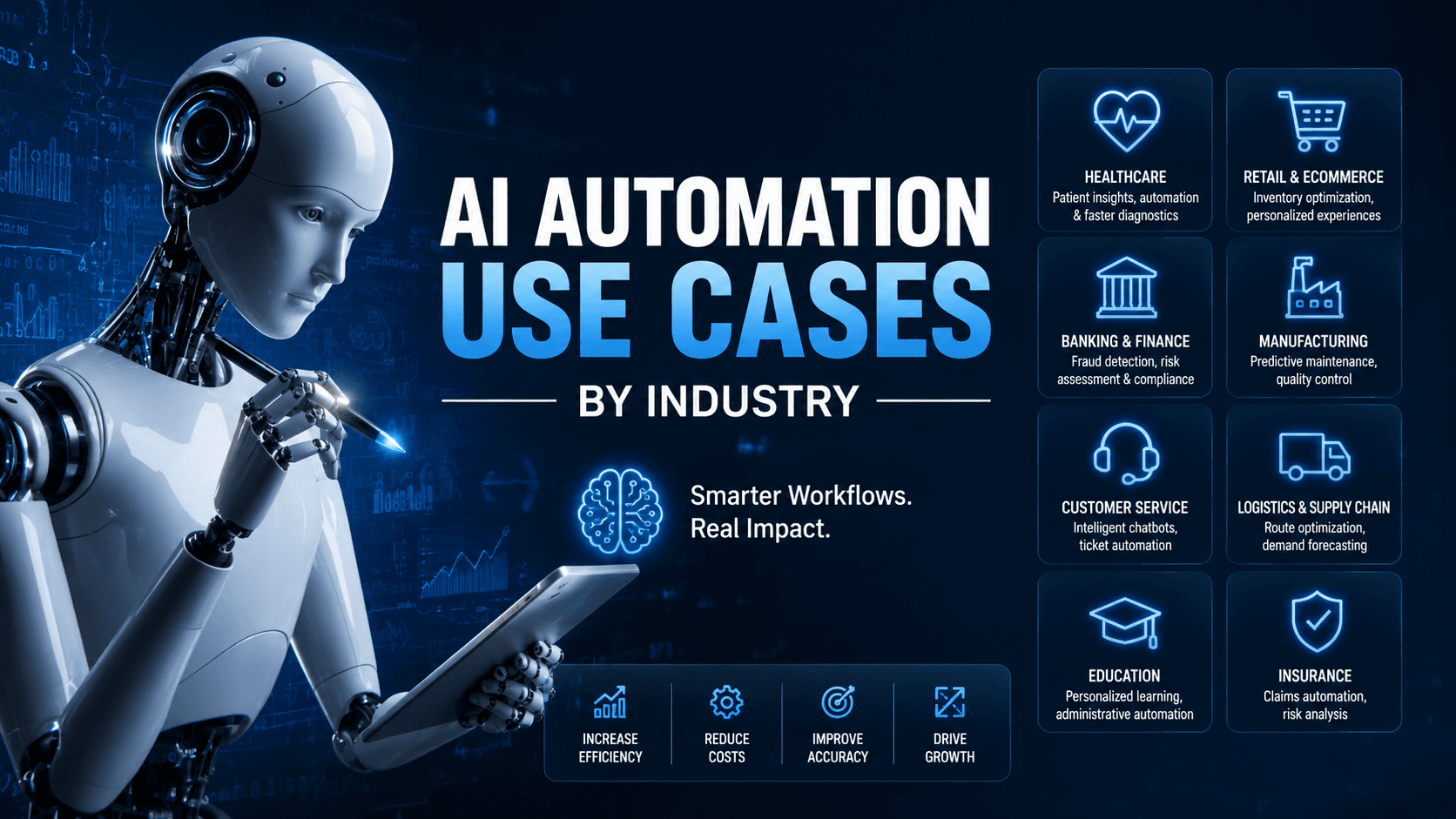
AI automation often gets discussed in generic terms, as if every business would use it the same way - but in practice, the most valuable use cases look very different depending on the industry. What matters to a retail business looks nothing like what matters to a healthcare provider or a financial services firm. This blog walks through real AI automation use cases across several industries, so you can see what's actually being applied right now, not just abstract possibilities.
Retail: Personalization and Inventory Intelligence
Retail businesses have embraced AI automation across both customer-facing and operational functions:
- Personalized product recommendations based on browsing and purchase history
- Automated customer support for order status, returns, and common questions
- Inventory forecasting that predicts demand and reduces overstock or stockouts
- Dynamic pricing adjustments based on demand patterns and competitor activity
The common thread across retail use cases is using data that already exists within the business to reduce manual guesswork and respond faster to customer behavior.
Healthcare: Administrative Relief and Patient Support
Healthcare providers face heavy administrative burdens alongside strict data sensitivity requirements, making automation particularly valuable in specific areas:
- Appointment scheduling and automated reminder systems
- Administrative documentation support, reducing manual paperwork
- Patient intake automation, collecting information before appointments
- Automated follow-up communications for routine care instructions
Healthcare automation tends to focus heavily on reducing administrative burden on staff, freeing up time for direct patient care, while remaining mindful of strict compliance and data privacy requirements throughout.
Finance: Fraud Detection and Process Efficiency
Financial services have long been early adopters of automation, particularly where speed and accuracy directly affect risk:
- Fraud detection systems that flag unusual transaction patterns in real time
- Automated document processing for loan applications or account onboarding
- Customer support automation for routine account inquiries
- Automated compliance monitoring and reporting
In finance, automation often serves a dual purpose - improving efficiency while also strengthening risk management and regulatory compliance.
Real Estate: Lead Qualification and Property Matching
Real estate businesses increasingly use automation to manage high volumes of inquiries and match buyers with relevant listings:
- Automated lead qualification and initial buyer or renter screening
- Property recommendation based on stated preferences and behavior
- Automated scheduling for property viewings
- Follow-up communication sequences for prospective buyers or tenants
Professional Services: Client Communication and Workflow Support
Firms offering professional services - legal, consulting, accounting - often use automation to handle repetitive client-facing and internal processes:
- Automated intake forms and initial client questionnaires
- Document review support, flagging items that need human attention
- Automated scheduling and follow-up communications
- Internal workflow automation for approvals and routine reporting
Hospitality: Guest Experience and Operational Efficiency
Hotels and hospitality businesses use automation to manage guest expectations around instant, always-available service:
- Automated booking confirmations and pre-arrival communication
- Chat-based support for common guest questions
- Personalized recommendations for services or local experiences
- Automated feedback collection after a stay
What These Industries Have in Common
Despite very different applications, a consistent pattern emerges across industries: the most effective AI automation targets repetitive, predictable tasks first, freeing people to focus on the parts of their work that genuinely require human judgment, empathy, or expertise.
Why Industry-Specific Automation Requires Thoughtful Software Development
Generic automation tools often fall short of an industry's specific needs, particularly in regulated fields like healthcare and finance where compliance requirements shape what automation can and can't do. This is where custom software development becomes valuable - building automation that respects industry-specific regulations and workflows, rather than forcing a one-size-fits-all tool into a specialized context.
Starting Point: Look at What Repeats
Regardless of industry, the clearest starting point for automation is identifying the tasks your team repeats most often with little variation - that's typically where automation delivers the fastest, most measurable return, before expanding into more complex use cases.
Frequently Asked Questions
Is AI automation equally applicable across every industry?
The core principle - automating repetitive tasks - applies broadly, but the specific use cases and regulatory considerations vary significantly depending on the industry.
Why does healthcare automation require extra caution compared to other industries?
Healthcare involves strict data privacy and compliance requirements, meaning automation must be built with those regulations in mind from the start, not added as an afterthought.
Which industry has adopted AI automation most extensively?
Finance and retail have been particularly early adopters, largely due to the volume of data and repetitive transactional processes well suited to automation.
Can a small business in one of these industries benefit from automation the same way large companies do?
Yes. Many of these use cases scale down effectively for smaller businesses, often starting with one focused automation rather than a full industry-wide rollout.
How do I know which automation use case applies to my specific industry?
Look at the repetitive, high-volume tasks specific to your business and industry - that's usually where the most relevant and effective automation opportunities exist.
Ready to Find Your Industry's Best Automation Opportunity?
The most effective AI automation isn't generic - it's built around how your specific industry actually operates. At Weboraz, we help you identify the automation opportunities most relevant to your business, not a one-size-fits-all package. With a hybrid US-India team spanning AI automation, software development, and web development, we build automation that fits your industry's real workflows and requirements.
Get a free automation assessment from Weboraz and find out what's possible for your industry.
Frequently asked questions
The core principle - automating repetitive tasks - applies broadly, but the specific use cases and regulatory considerations vary significantly depending on the industry.
Healthcare involves strict data privacy and compliance requirements, meaning automation must be built with those regulations in mind from the start, not added as an afterthought.
Finance and retail have been particularly early adopters, largely due to the volume of data and repetitive transactional processes well suited to automation.
Yes. Many of these use cases scale down effectively for smaller businesses, often starting with one focused automation rather than a full industry-wide rollout.
Look at the repetitive, high-volume tasks specific to your business and industry - that's usually where the most relevant and effective automation opportunities exist.
Related Articles
Need help applying this?
Our team can turn the ideas in this article into a clear plan and a polished build.
Contact Us