Automation terminology has multiplied faster than most business owners can keep up with, and RPA, AI automation, and hyperautomation often get used as if they're interchangeable - when in reality, they represent different levels of capability, with hyperautomation actually building on top of the other two. Misunderstanding the difference can lead to choosing the wrong approach, or assuming you need something far more complex than your business actually does. This blog breaks down what each term actually means, and how they relate to one another.
RPA: Automating Individual, Rule-Based Tasks
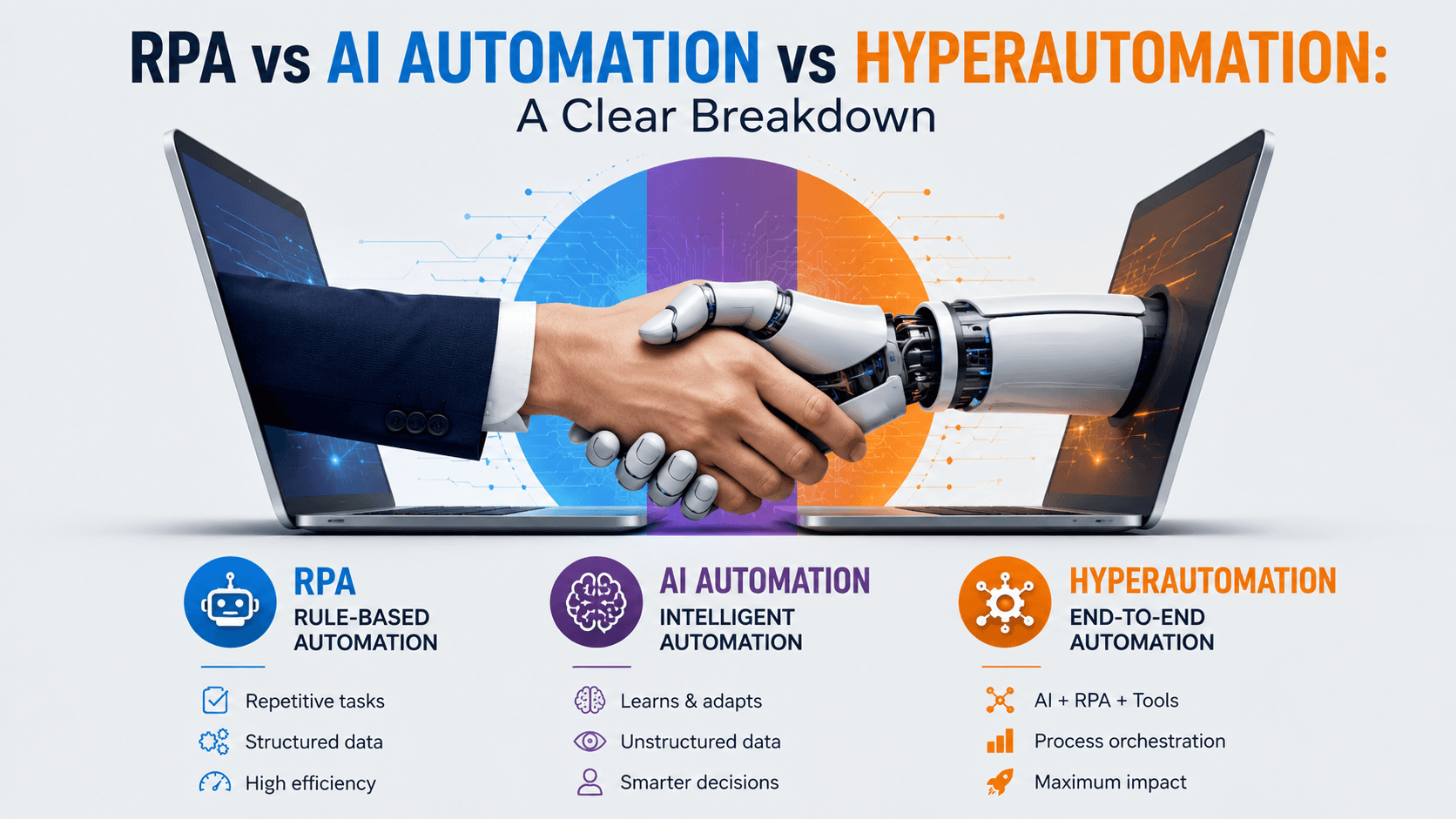
RPA, or robotic process automation, follows fixed, predefined rules to automate repetitive tasks - think of it as a digital worker executing the exact same steps every time, with no interpretation or judgment involved.
RPA works well for:
- Simple, repetitive tasks that never really change
- Moving data between systems in a consistent, predictable format
- Processes where every scenario can be explicitly programmed in advance
RPA's strength is reliability within a narrow, well-defined scope - but it breaks down the moment a process involves variation or judgment.
AI Automation: Automating Judgment-Based Decisions
AI automation goes a step further, using artificial intelligence to interpret unstructured information, make context-based decisions, and adapt to variation that RPA can't handle on its own.
AI automation works well for:
- Understanding and responding to natural language, like customer inquiries
- Making decisions based on patterns rather than fixed rules
- Handling exceptions or unusual cases without requiring a human to step in every time
Where RPA automates tasks, AI automation automates decisions - a meaningful difference in capability, not just a difference in sophistication.
Hyperautomation: Combining Everything Into One Coordinated System
Hyperautomation isn't a separate technology on its own — it's a strategic approach that combines RPA, AI automation, process mining, and other automation tools into one coordinated system, automating entire end-to-end business processes rather than isolated tasks.
Hyperautomation typically involves:
- Identifying and mapping processes across the business worth automating, often using process mining tools
- Combining RPA for simple, repetitive steps with AI automation for judgment-based decisions within the same process
- Orchestrating multiple automated components together into a single, coordinated workflow
- Continuously monitoring and refining automated processes over time
A Simple Way to Understand the Relationship
Think of it this way: RPA and AI automation are individual tools, while hyperautomation is the strategic framework for combining multiple tools together across an entire process, rather than automating isolated pieces of it in disconnected efforts.
A single customer onboarding process, for example, might use RPA to move data between systems, AI automation to interpret submitted documents, and coordinated orchestration to manage the entire workflow end to end - that combined system is hyperautomation in practice.
When RPA Alone Is Sufficient
Not every business needs hyperautomation, or even AI automation. RPA alone remains the right choice when:
- The process in question is simple, repetitive, and genuinely unchanging
- Cost efficiency matters more than handling variation or judgment
- The scope of automation is narrow and well-defined
When AI Automation Is the Right Level
AI automation becomes the better fit when a process involves genuine variation, unstructured data, or decisions that can't be reduced to fixed rules - but doesn't necessarily require automating an entire cross-system business process end to end.
When Hyperautomation Actually Makes Sense
Hyperautomation tends to be worth the added complexity for larger organizations with multiple interconnected, high-volume processes spanning several systems and departments, where the cumulative value of automating an entire workflow - not just individual tasks - justifies the more significant strategic and technical investment involved.
For smaller or mid-size businesses, starting with targeted RPA or AI automation on specific bottlenecks often delivers strong value without the complexity of a full hyperautomation strategy.
Why This Requires Thoughtful Software Development
Whether implementing RPA, AI automation, or hyperautomation, the underlying architecture connecting these tools together matters significantly. Poorly integrated automation components can create fragile systems that break easily, which is why solid software development practices matter as much as the automation tools themselves.
Avoiding the Common Mistake: Jumping to Hyperautomation Too Early
Businesses sometimes assume hyperautomation is the more advanced, and therefore better, choice - without first identifying whether their actual needs justify that level of complexity. Starting with a clear, specific automation need, then scaling up in sophistication only as genuinely required, tends to produce better results than starting with the most advanced option available.
Frequently Asked Questions
Is hyperautomation just a more advanced version of AI automation?
Not exactly. Hyperautomation is a strategic approach that combines RPA, AI automation, and other tools into one coordinated system, rather than a single more advanced automation technology on its own.
Does every business need hyperautomation eventually?
No. Many businesses are well served by targeted RPA or AI automation for specific processes, without needing the broader, more complex coordination that hyperautomation involves.
Can RPA and AI automation be used without hyperautomation?
Yes, and this is common. Many businesses use RPA or AI automation independently for specific tasks without implementing a full hyperautomation strategy.
What's the biggest risk of jumping straight to hyperautomation?
Businesses risk investing in complexity they don't actually need, when a more targeted RPA or AI automation solution would have addressed the real bottleneck more efficiently.
How do I know which level of automation my business actually needs?
Start by identifying your specific bottleneck or repetitive process, then match its complexity - simple and rule-based points toward RPA, judgment-based points toward AI automation, and multiple interconnected processes point toward hyperautomation.
Not Sure Which Level of Automation You Actually Need?
RPA, AI automation, and hyperautomation each solve a different problem - and the right starting point depends on your actual bottleneck, not the most advanced-sounding option. At Weboraz, we help you figure out exactly where your business fits, rather than defaulting to the most complex solution. With a hybrid US-India team spanning AI automation, software development, and web development, we build automation that matches your real needs, at the right level of complexity.
Get a free automation strategy consultation from Weboraz and find out which level fits your business.