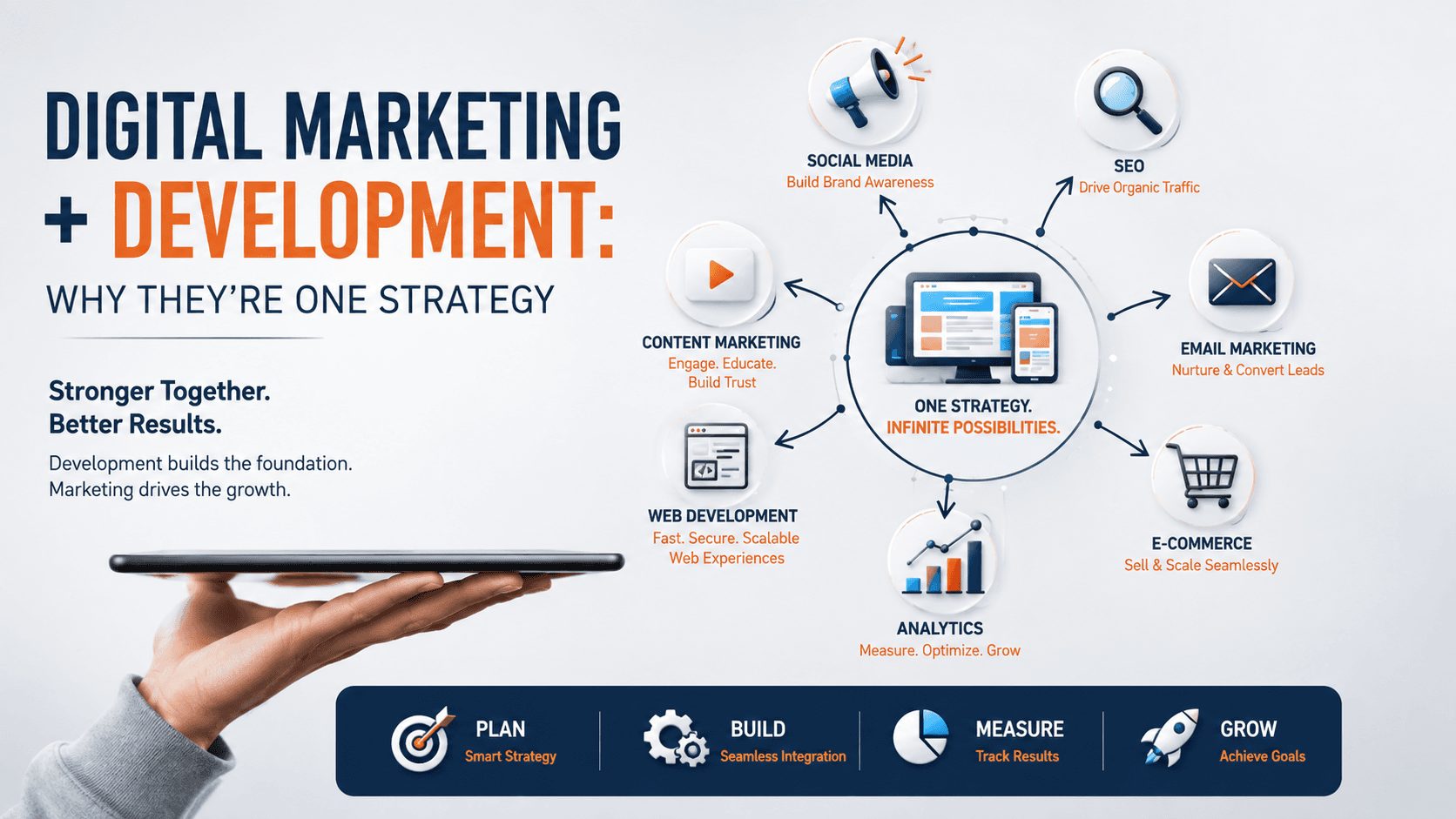
Many businesses run digital marketing and website development as two entirely separate efforts - different teams, different priorities, and often different timelines that only intersect briefly at launch. This separation seems efficient on paper, but it frequently produces campaigns that drive traffic to a site that can't convert it well, or a beautifully built site that marketing struggles to get any visibility for. This blog explains why digital marketing and development work far better as one connected strategy, not two disconnected ones.
Why This Separation Happens in the First Place
Marketing and development require different skill sets, so it's natural for businesses to treat them as separate departments or vendors. The problem isn't the specialization itself - it's when these two functions operate without any real coordination, each optimizing for their own goals without understanding how their work affects the other.
What Goes Wrong When They're Disconnected
When marketing and development operate in silos, common problems include:
- Ad campaigns driving traffic to pages that aren't built to convert that specific intent
- SEO strategies built without development's input on technical feasibility
- Website redesigns that unintentionally break existing SEO rankings marketing worked hard to build
- Marketing requesting landing pages or features development wasn't planned or budgeted for
- Development building a beautiful site that marketing then struggles to make discoverable
Each of these problems is avoidable, but only when both functions understand what the other is actually trying to achieve.
Why Development Needs to Understand Marketing Goals
A website isn't just a technical asset - it's often the primary destination for marketing efforts, meaning its structure, speed, and design directly affect campaign performance. When development is built with marketing goals in mind from the start, it becomes far easier to:
- Build landing pages optimized for specific campaign intents
- Structure the site in a way that supports SEO strategy, not just visual design
- Avoid technical decisions that accidentally undermine tracking, analytics, or conversion paths
Why Marketing Needs to Understand Technical Constraints
Marketing strategies built without awareness of technical reality often generate requests that are expensive, unrealistic, or poorly timed. When marketing understands the underlying web development process, it becomes easier to:
- Plan campaigns around realistic development timelines
- Request features that align with what the platform can actually support
- Avoid promising functionality that would require significant, unplanned development work
Where the Two Strategies Naturally Overlap
Several areas make the connection between marketing and development especially clear:
- SEO and technical performance - site speed, structure, and mobile responsiveness all directly affect search rankings, meaning development decisions are inherently part of the SEO strategy
- Conversion rate optimization - marketing's understanding of what drives conversions should directly inform how pages are built and structured
- Campaign-specific landing pages - these require close coordination between marketing's messaging goals and development's build capacity
- Site redesigns - marketing input is essential to avoid unintentionally damaging existing SEO equity during a redesign
How Custom Software Can Bridge This Gap More Effectively
Off-the-shelf marketing tools and generic website templates often force marketing and development into disconnected workflows, since each system operates independently. Custom software development allows marketing tools, analytics, and the website itself to be built as one integrated system, reducing the friction that comes from stitching together disconnected platforms after the fact.
Bringing AI Automation Into a Unified Strategy
When marketing and development are aligned, AI automation becomes significantly more effective - automated lead follow-ups, personalized content, or smart chat support can be built directly into the site's structure and marketing funnel together, rather than added as a disconnected feature that neither team fully owns.
Practical Ways to Bridge the Gap
Businesses don't need to merge marketing and development into a single department to fix this disconnect. Practical steps include:
- Involving development early in marketing strategy planning, not just at execution
- Involving marketing early in website redesign or rebuild planning
- Establishing shared goals and metrics both teams are accountable to
- Regular communication between both functions, rather than only interacting at project handoffs
Why This Alignment Matters More As Businesses Scale
As marketing efforts grow more sophisticated and websites become more complex, the cost of misalignment between the two grows as well. Businesses that treat marketing and development as one connected strategy from early on tend to avoid the expensive rework and missed opportunities that come from realizing the disconnect only after problems surface.
Frequently Asked Questions
Do marketing and development need to be handled by the same team to work well together?
Not necessarily the same team, but they do need consistent communication and shared understanding of each other's goals, regardless of whether they're internal or separate providers.
How does website development directly affect marketing performance?
Site speed, structure, and mobile responsiveness all influence SEO rankings and conversion rates, meaning technical decisions have a direct impact on marketing results.
What's the most common problem caused by disconnected marketing and development?
Campaigns driving traffic to pages that aren't built to convert that specific intent is one of the most common and costly disconnects between the two functions.
Can a website redesign hurt existing marketing results?
Yes, if marketing isn't involved in the planning process, a redesign can unintentionally damage existing SEO rankings or break tracking and conversion paths.
How can a business start aligning marketing and development more effectively?
Involving each function early in the other's planning process, and establishing shared goals both teams are accountable to, is a practical starting point.
Ready to Bring Marketing and Development Together?
Treating marketing and development as one connected strategy, rather than two separate handoffs, is where real performance gains tend to live. At Weboraz, we approach every project with both in mind from the start, so your website and your marketing actually work toward the same goals. With a hybrid US-India team spanning web development, software development, and AI automation, we build with your growth strategy built in, not bolted on.
Get a free strategy consultation from Weboraz and see how aligned marketing and development could work for your business.