
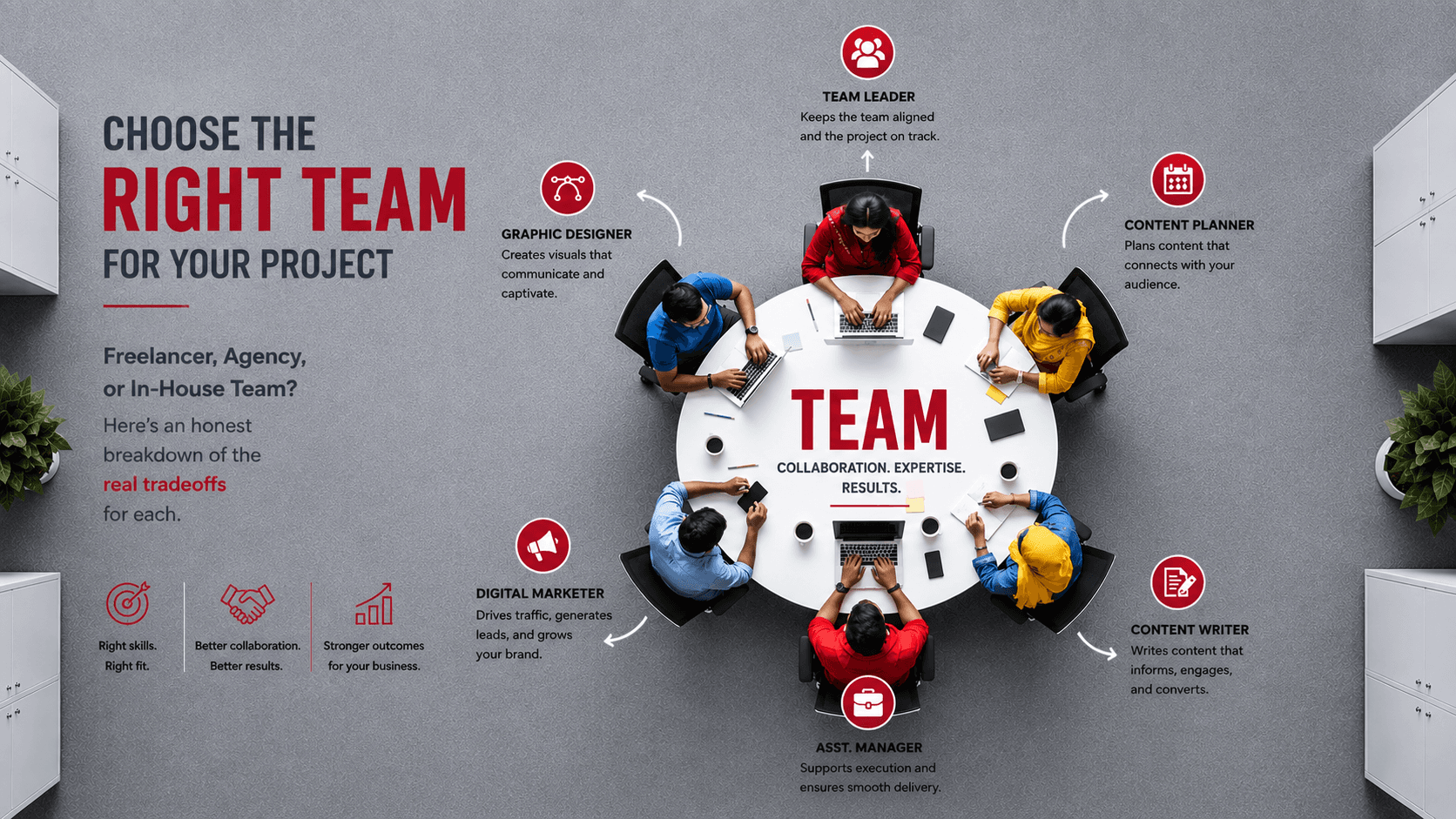
Deciding who actually builds your project - a freelancer, an agency, or an in-house team - is a decision that shapes cost, quality, and reliability far more than most businesses initially expect. Each option comes with real, honest tradeoffs, and the right choice depends heavily on your specific project, timeline, and long-term plans, not just which option looks cheapest on paper. This blog breaks down how freelancers, agencies, and in-house teams actually compare, so you can choose with clear eyes.
What Working With a Freelancer Actually Looks Like
Freelancers are independent individuals who take on projects directly, often at a lower cost than an agency due to lower overhead.
Strengths:
- Generally lower cost than hiring an agency or building an in-house team
- Direct communication with the person actually doing the work
- Flexibility to bring someone on for a specific, defined task
Tradeoffs:
- Limited capacity - one person can only do so much, and timelines can slip if they're juggling multiple clients
- Less redundancy if the freelancer becomes unavailable mid-project
- May lack breadth of skills for projects requiring multiple specializations
What Working With an Agency Actually Looks Like
Agencies bring a team with a range of specialized skills, along with established processes for managing projects from start to finish.
Strengths:
- Access to a broader skill set - design, development, project management, testing - under one roof
- Established processes for quality assurance, communication, and project management
- Built-in redundancy, since the project isn't dependent on a single individual
Tradeoffs:
- Generally higher cost than a freelancer, reflecting the broader team and overhead
- Communication sometimes flows through a project manager rather than directly with developers
- Quality and process can vary significantly between agencies, requiring careful vetting
What Building an In-House Team Actually Looks Like
An in-house team means hiring employees directly, giving your business full-time, dedicated technical resources.
Strengths:
- Deep, ongoing familiarity with your business, systems, and long-term goals
- Full control over priorities, timeline, and day-to-day direction
- No dependency on external availability or competing client priorities
Tradeoffs:
- Significantly higher fixed cost, including salaries, benefits, and overhead
- Slower to scale up or down compared to external options
- Requires internal technical leadership to manage effectively
Matching the Option to Your Project's Complexity
- Simple, well-defined, one-off tasks → a freelancer is often sufficient and cost-effective
- Larger, multi-faceted projects requiring several specializations → an agency typically delivers more reliable results
- Ongoing, evolving technical needs central to your business → an in-house team becomes worth the investment over time
Considering Your Timeline and Urgency
Freelancers can sometimes start quickly but may have limited capacity for larger scope. Agencies generally have more resources to move faster on bigger projects but require a proper onboarding and scoping process. In-house teams take the longest to establish but offer the fastest ongoing turnaround once in place, since they're already embedded in your business.
Budget Considerations Beyond the Sticker Price
Comparing hourly or project rates alone misses important context. A freelancer's lower rate can become costly if delays or quality issues require rework. An agency's higher rate often reflects built-in quality assurance and project management that reduces risk. An in-house team's fixed cost needs to be weighed against consistent, ongoing work volume that justifies a full-time hire.
Why Some Businesses Use a Hybrid Approach
Many businesses don't choose exclusively one option - they use freelancers for smaller, specific tasks, an agency for larger custom software development projects, and gradually build in-house capacity as their technical needs become more central and ongoing to the business.
The Role of Communication and Process, Regardless of Option
Whichever option you choose, clear communication and defined processes matter significantly. A well-organized freelancer can outperform a disorganized agency, and vice versa - the structure and reliability of how work actually gets managed often matters as much as which category you choose.
Where AI Automation and Mobile Development Fit Into This Decision
Specialized needs like AI automation or mobile app development sometimes require specific expertise that influences this decision - an agency or specialized freelancer with direct experience in these areas can be more valuable than a generalist, regardless of which category you're otherwise leaning toward.
Frequently Asked Questions
Is a freelancer always cheaper than an agency?
Generally yes for the initial rate, but freelancer engagements can become more expensive overall if delays, limited capacity, or quality issues require additional rework.
When does it make sense to hire an in-house team instead of an agency?
When technical needs are ongoing, central to the business, and substantial enough to justify the fixed cost of full-time employees rather than project-based work.
Can I switch between these options as my project evolves?
Yes, and many businesses do - starting with a freelancer or agency, then building in-house capacity later once technical needs become more consistent and central to operations.
How do I know if an agency is reliable before committing to a project?
Evaluating their process, communication style, and relevant experience during initial conversations is usually more revealing than portfolio alone.
Is a hybrid approach using multiple options at once common?
Yes, many businesses combine freelancers, agencies, and in-house resources depending on the specific need, rather than committing exclusively to one option.
Not Sure Which Option Fits Your Project?
Freelancer, agency, or in-house isn't a one-size-fits-all decision - it depends on your project's complexity, timeline, and long-term technical needs. At Weboraz, we help you think through this honestly, based on what your project actually requires. With a hybrid US-India team spanning web development, software development, mobile app development, and AI automation, we bring agency-level breadth with the reliability and communication your project deserves.
Get a free project consultation from Weboraz and find out what team structure fits your needs.
Frequently asked questions
Generally yes for the initial rate, but freelancer engagements can become more expensive overall if delays, limited capacity, or quality issues require additional rework.
When technical needs are ongoing, central to the business, and substantial enough to justify the fixed cost of full-time employees rather than project-based work.
Yes, and many businesses do - starting with a freelancer or agency, then building in-house capacity later once technical needs become more consistent and central to operations.
Evaluating their process, communication style, and relevant experience during initial conversations is usually more revealing than portfolio alone.
Yes, many businesses combine freelancers, agencies, and in-house resources depending on the specific need, rather than committing exclusively to one option.
Related Articles
Need help applying this?
Our team can turn the ideas in this article into a clear plan and a polished build.
Contact Us