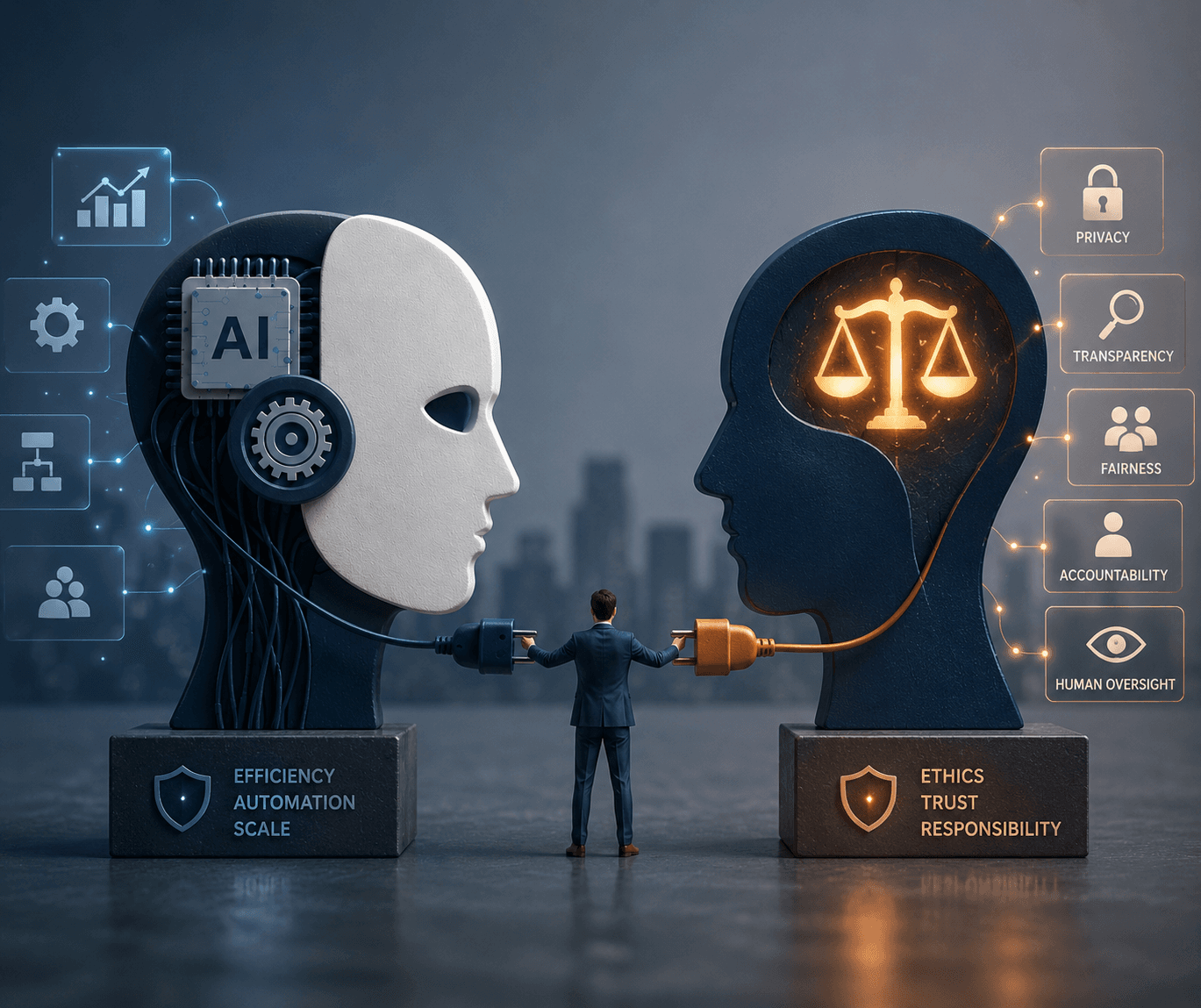
AI automation gets discussed constantly in terms of efficiency and cost savings, but businesses adopting it also take on real ethical responsibility - around transparency, fairness, data handling, and knowing where automation genuinely shouldn't replace human judgment. Treating these questions as an afterthought, rather than part of the initial planning, tends to create problems that are harder to fix once automation is already embedded in daily operations. This blog looks honestly at the ethical considerations and practical limits businesses should think through with AI automation.
Transparency: Should Customers Know They're Talking to AI?
One of the clearest ethical questions in AI automation is whether customers should be told they're interacting with an automated system rather than a human. Many businesses default to disclosure, and for good reason - most customers respond better to automation when it's transparent, rather than feeling misled after the fact when they realize they weren't talking to a person.
Being upfront about automation, while still making the experience smooth and helpful, tends to build more trust than concealment ever does.
Data Privacy and Consent
AI automation often relies on customer data to function effectively, which raises real responsibilities around:
- Being clear about what data is collected and how it's used
- Obtaining proper consent, not just relying on buried fine print
- Limiting data collection to what's genuinely necessary for the automation to work
- Protecting collected data with appropriate security measures
Businesses that treat data privacy as a genuine priority, not just a compliance checkbox, tend to maintain stronger customer trust over time.
The Risk of Bias in Automated Decisions
AI systems can inadvertently reflect biases present in the data they're built on, which becomes a genuine ethical concern when automation influences decisions that affect people - such as loan approvals, hiring processes, or pricing. Businesses using AI automation for these kinds of decisions have a responsibility to actively test for and address unfair bias, rather than assuming automation is inherently neutral.
Where Human Judgment Shouldn't Be Replaced
Not every decision belongs in the hands of automation, regardless of how sophisticated the system is. Situations that generally warrant human judgment include:
- Sensitive customer complaints or emotionally charged situations
- Decisions with significant consequences for an individual, like financial or employment-related outcomes
- Complex, ambiguous situations that don't fit clean, predictable patterns
- Any interaction where empathy and nuance matter more than speed
Recognizing these boundaries isn't a limitation of automation - it's a responsible use of it.
The Risk of Over-Automating Customer Relationships
There's a real risk in automating so much of customer interaction that businesses lose genuine touchpoints with their customers, reducing relationships to purely transactional exchanges. Even as efficiency improves, maintaining some deliberate human connection points helps preserve the trust and loyalty that purely automated relationships often struggle to build.
Accountability When Automation Gets Something Wrong
When an automated system makes a mistake, businesses need clear accountability structures - who reviews and corrects errors, how customers can escalate issues, and how the business takes responsibility rather than treating "the AI did it" as an excuse that absolves genuine accountability.
The Limits of What AI Automation Can Reliably Do
Beyond ethics, there are practical limits worth acknowledging honestly:
- AI automation performs best on patterns it's been trained on, and can struggle significantly with genuinely novel situations
- Automation is only as good as the data and integration behind it - poor underlying software development limits its real-world reliability
- Automation can create a false sense of "it's handled," when ongoing monitoring and refinement are actually still required
Building Ethical Considerations Into the Development Process
The most responsible approach treats ethical considerations as part of initial planning during software development, rather than an afterthought addressed only after concerns are raised publicly. This includes deliberately designing for transparency, testing for bias, and clearly defining where automation's role ends and human judgment begins.
Why This Matters for Long-Term Trust, Not Just Compliance
Businesses that think through these questions thoughtfully tend to build more durable customer trust than those treating ethics purely as a legal or compliance requirement. Genuine consideration of these limits often results in automation that customers actually feel good about interacting with, not just automation that's technically permissible.
Frequently Asked Questions
Should businesses always disclose when customers are interacting with AI?
Most businesses find that disclosure builds more trust than concealment, especially since customers often respond negatively to discovering they were misled about interacting with automation.
Can AI automation be biased even if a business didn't intend it to be?
Yes. AI systems can reflect biases present in their training data, which is why active testing and monitoring for unfair outcomes is an important ongoing responsibility.
What kinds of decisions should never be fully automated?
Decisions with significant consequences for an individual, sensitive or emotionally charged situations, and complex cases without clear patterns generally warrant human involvement.
Who is responsible when an automated system makes a mistake?
The business remains accountable, requiring clear processes for review, correction, and customer escalation, rather than treating automation as removing responsibility.
Does ethical AI automation cost more to implement?
It can require more upfront planning and testing, but this investment tends to prevent more costly reputational and trust issues that arise from poorly considered automation later.
Ready to Automate Thoughtfully, Not Just Efficiently?
Responsible AI automation means thinking through transparency, fairness, and where human judgment still matters, not just chasing efficiency at any cost. At Weboraz, we build automation with these considerations in mind from the start, so it earns customer trust rather than risking it. With a hybrid US-India team spanning AI automation, software development, and web development, we help you automate in a way you can genuinely stand behind.
Get a free AI strategy consultation from Weboraz and find out how to automate responsibly for your business.