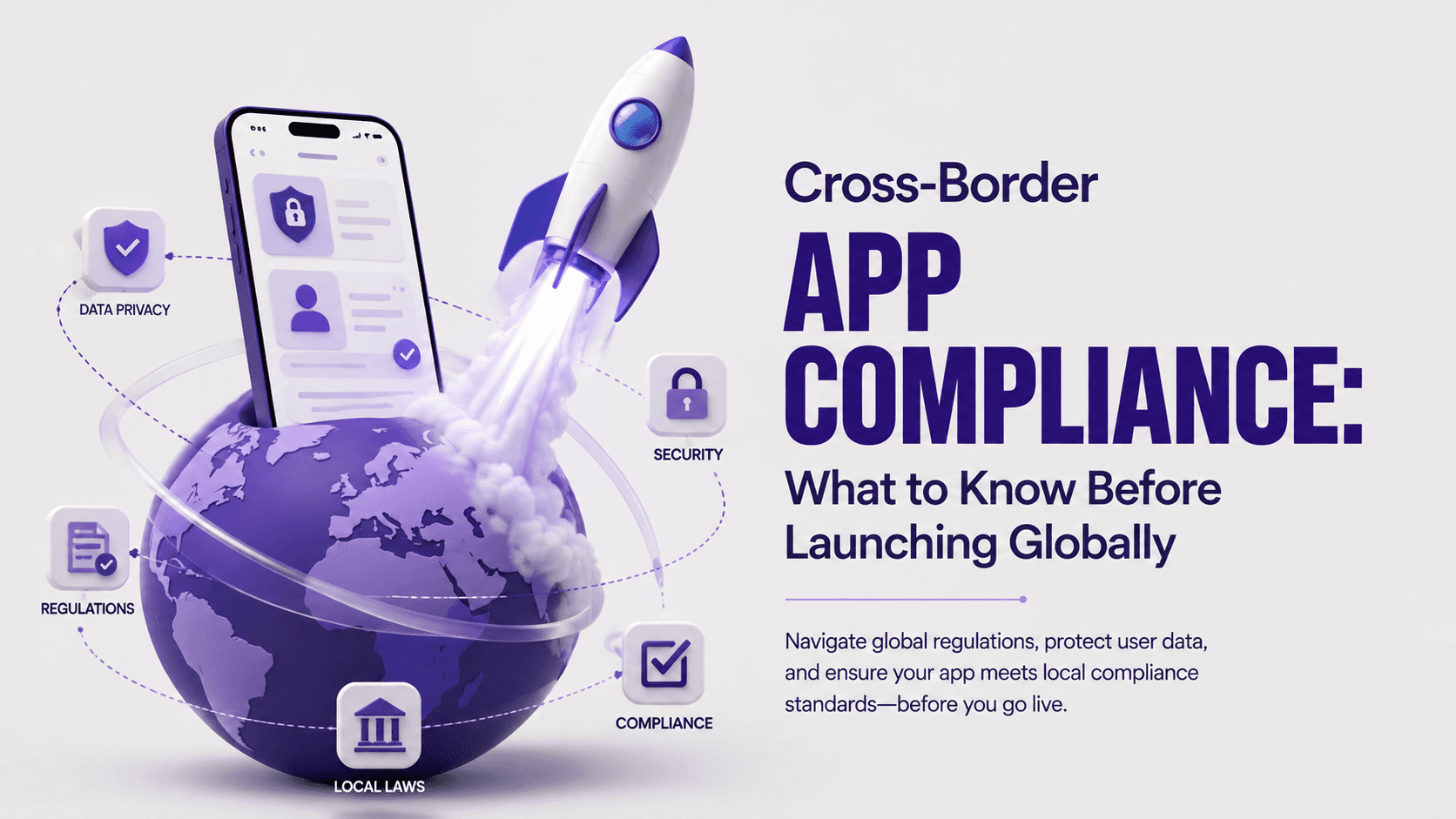
Launching an app internationally often gets planned around translation, currency support, and localization - while compliance requirements, which vary significantly from country to country, get discovered much later, sometimes only after a regulatory issue or app store rejection forces the conversation. Understanding these requirements before launch, not after, prevents costly delays and legal exposure. This blog walks through what founders actually need to know about cross-border app compliance before expanding globally.
Why Compliance Isn't a Single, Universal Standard
A common assumption is that meeting one country's requirements - often the founder's home market - is sufficient everywhere. In reality, data protection laws, consumer rights regulations, and app store requirements differ meaningfully by region, meaning compliance needs to be evaluated separately for each market you're entering, not assumed to transfer automatically.
Data Privacy Regulations Vary Significantly by Region
Different regions have distinct data protection frameworks, each with its own specific requirements around consent, data storage, and user rights. Before launching in a new market, it's essential to understand:
- What counts as personal data under that region's specific regulations
- What consent mechanisms are required before collecting user data
- Where data must be stored, and whether cross-border data transfer restrictions apply
- What rights users have regarding their own data, such as access or deletion requests
Treating data privacy as a single global standard, rather than researching region-specific requirements, is one of the most common and costly compliance mistakes.
App Store Requirements Differ by Country
Beyond general platform guidelines, both major app stores enforce additional, country-specific requirements in certain regions - covering areas like payment processing, content restrictions, or specific disclosures. Reviewing these requirements for each target market prevents unexpected rejections or delays during the submission process.
Payment and Financial Regulations
If your app processes payments, financial regulations can vary substantially by country, including requirements around:
- Approved payment methods and processors for that specific region
- Currency handling and displayed pricing requirements
- Tax collection and reporting obligations tied to that market
These requirements often require local expertise to navigate accurately, rather than assuming a single payment integration works identically everywhere.
Content and Regulatory Restrictions
Certain types of content, functionality, or business models face specific restrictions in some countries that don't exist elsewhere. This is particularly relevant for apps involving financial services, healthcare, or user-generated content, where regulatory scrutiny tends to be higher and more specific to local law.
Accessibility Requirements Can Vary by Region Too
While accessibility is a widely recognized best practice, some regions have specific legal requirements around digital accessibility that others don't formally enforce, making it worth confirming what's legally required, not just generally advisable, in each target market.
Localization Goes Beyond Language Translation
True localization for compliance purposes includes more than translated text - it often means adjusting terms of service, privacy policies, and disclosures to reflect the specific legal requirements of each market, rather than using a single global document across every region.
Why This Requires Planning During Development, Not After Launch
Building compliance considerations into custom software development from the start - rather than retrofitting them after expanding into a new market - tends to be significantly less disruptive and costly. This includes architectural decisions around data storage and handling that are much harder to change after launch than to plan for upfront.
Building a Realistic Global Launch Sequence
Rather than launching in every target market simultaneously, many businesses find it more manageable to expand into new regions sequentially, allowing time to properly research and implement compliance requirements for each market before moving to the next, rather than attempting to solve every region's requirements at once.
When to Involve Legal Expertise
While development and planning can address much of the technical side of compliance, involving legal expertise familiar with the specific regions you're entering is essential for interpreting requirements accurately and avoiding costly misunderstandings, particularly around data privacy and financial regulations.
Where AI Automation Fits Into Compliance Management
Some businesses use AI automation to help monitor and flag content or data handling practices that may not align with a specific region's requirements, adding a layer of proactive oversight as an app operates across multiple regulatory environments simultaneously.
Frequently Asked Questions
Is meeting data privacy requirements in one country enough for a global launch?
No. Data protection requirements vary significantly by region, meaning compliance needs to be evaluated separately for each market rather than assumed to transfer automatically.
Do app store requirements really differ by country?
Yes, in certain regions. Beyond general platform guidelines, some countries have additional, specific requirements around payments, content, or disclosures that need to be reviewed individually.
Should compliance be addressed before or during development?
Ideally during development. Building compliance considerations into the architecture from the start is significantly less disruptive than retrofitting them after a market launch.
Is legal expertise necessary for launching an app internationally?
Generally yes, particularly for interpreting region-specific data privacy and financial regulations accurately, since these requirements can be complex and vary significantly by jurisdiction.
Is it better to launch globally all at once or expand gradually?
Expanding sequentially into new markets is often more manageable, allowing proper compliance research and implementation for each region before moving to the next.
Ready to Plan a Compliant Global Launch?
Launching globally involves more moving parts than translation and currency support - and compliance is one of the costliest things to get wrong after the fact. At Weboraz, we help you think through these requirements early, so expansion doesn't stall on preventable regulatory issues. With a hybrid US-India team spanning mobile app development, software development, and AI automation, we help you build for global reach the right way.
Get a free global launch consultation from Weboraz and find out what compliance your app actually needs.