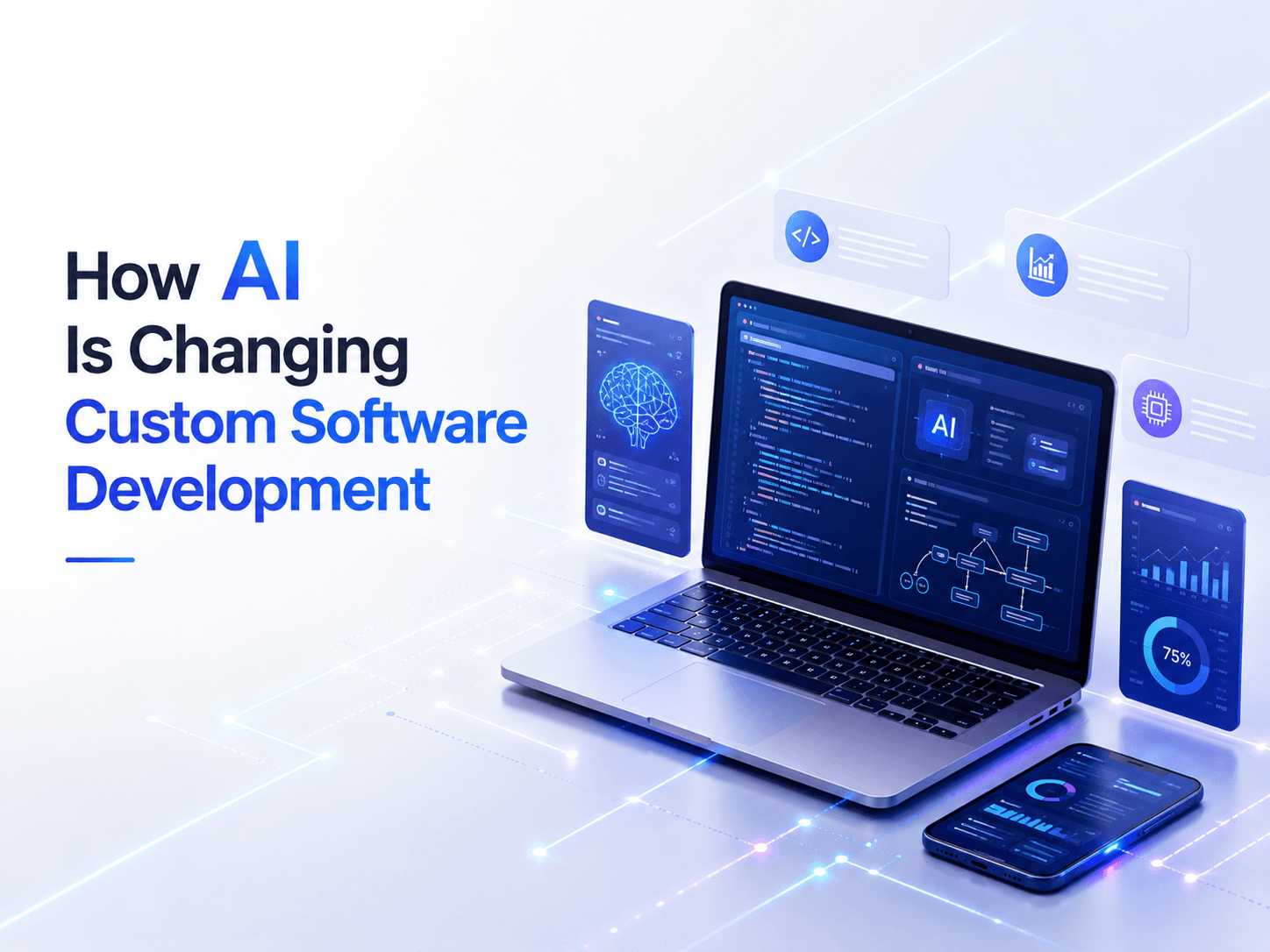
For years, AI in software conversations mostly meant a feature added to the finished product - a recommendation engine, a chatbot, some automated workflow. That's still true, but a quieter, more fundamental shift is also underway: AI is changing how software itself actually gets built, not just what it does once it's finished. This blog looks at how AI is reshaping custom software development, from planning through delivery.
AI-Assisted Coding Is Changing Developer Productivity
One of the most visible changes is how developers write code in the first place. AI-assisted coding tools can suggest code, catch errors early, and handle repetitive coding patterns, allowing developers to focus more time on complex logic and architecture rather than routine implementation work.
This doesn't replace the developer's judgment - it changes where their time and attention are spent during the development process itself.
Faster Prototyping and Iteration
AI tools are making it faster to go from an idea to a working prototype, allowing businesses to test concepts and gather feedback earlier in the process than traditional development timelines historically allowed. This shift supports a more iterative approach, where ideas can be validated and refined faster before committing to full-scale development.
AI-Assisted Testing and Quality Assurance
Testing has traditionally required significant manual effort to cover the range of scenarios a piece of software might encounter. AI-assisted testing tools can now identify edge cases, generate test scenarios, and catch certain categories of bugs more efficiently, improving software quality while reducing some of the manual testing burden on development teams.
Smarter Code Review and Bug Detection
Beyond writing code, AI is also changing how code gets reviewed. Automated analysis can flag potential security vulnerabilities, performance issues, or code quality concerns earlier in the process, complementing human code review rather than replacing the judgment experienced developers bring to reviewing a colleague's work.
AI Changing How Requirements Get Translated Into Software
Some of the most interesting shifts are happening earlier in the process, at the requirements and planning stage. AI tools can help translate business requirements into more structured technical specifications faster, supporting - though not replacing - the thoughtful planning that still needs human judgment about what the business actually needs.
Custom Software Becoming More Accessible for Smaller Businesses
As AI tools make certain parts of development more efficient, the cost and timeline barriers that once made custom software development inaccessible for smaller businesses are gradually lowering. This doesn't mean custom development is becoming trivial, but it is becoming a more realistic option for businesses that previously assumed it was out of reach.
AI Enabling More Personalized, Adaptive Software From the Start
Rather than adding AI-driven personalization as an afterthought, more custom software is now being architected with AI automation built into its core structure from the beginning - adaptive interfaces, predictive functionality, and intelligent workflows designed in from day one, rather than retrofitted later.
The Human Judgment That AI Still Can't Replace
Despite these shifts, AI hasn't replaced the core judgment required in custom software development - understanding a business's actual problem, making architectural tradeoffs, and translating ambiguous human needs into a coherent technical solution still require experienced human decision-making that AI tools support, rather than substitute for.
Why This Requires Development Partners to Evolve Their Own Practices
Development teams that effectively incorporate these AI-assisted tools into their own workflow - without over-relying on them for decisions that still require human judgment - tend to deliver software faster and with fewer errors, while teams slow to adapt risk falling behind on both speed and quality expectations that AI-assisted development is gradually establishing as the new baseline.
What This Means for Businesses Considering Custom Software
For businesses evaluating custom software development, this shift is generally good news - faster iteration, more efficient testing, and gradually more accessible pricing, without sacrificing the thoughtful human judgment that determines whether the final software actually solves the right problem.
Frequently Asked Questions
Is AI replacing software developers?
Not in the sense of replacing human judgment - AI tools are changing where developers spend their time, handling repetitive tasks while developers focus more on architecture, logic, and judgment calls AI can't make.
Does AI-assisted development make custom software cheaper?
It can contribute to more efficient development in certain areas, which may gradually make custom software more accessible, though cost still depends heavily on the specific project's complexity.
Can AI fully handle testing and quality assurance on its own?
No. AI-assisted testing tools improve efficiency and catch certain issues faster, but they complement rather than fully replace thorough human oversight in quality assurance.
Does AI change how businesses should think about planning a custom software project?
The core planning principles remain the same, though AI tools can help translate requirements into technical specifications more efficiently once priorities and goals are clearly defined.
Should businesses wait for AI-assisted development to mature further before investing in custom software?
Not necessarily. These tools are already delivering real efficiency gains today, and waiting indefinitely for further maturity often means missing the practical benefits already available now.
Ready to Build Custom Software the Modern Way?
AI is changing how software gets built, but the judgment behind building the right software still comes down to genuinely understanding your business. At Weboraz, we use modern AI-assisted development practices while keeping human judgment at the center of every decision that actually matters. With a hybrid US-India team spanning software development, web development, mobile app development, and AI automation, we build software for where development is headed, not where it used to be.
Get a free custom software consultation from Weboraz and see how we build smarter, faster, and still thoughtfully.
Frequently asked questions
Not in the sense of replacing human judgment — AI tools are changing where developers spend their time, handling repetitive tasks while developers focus more on architecture, logic, and judgment calls AI can't make.
It can contribute to more efficient development in certain areas, which may gradually make custom software more accessible, though cost still depends heavily on the specific project's complexity.
No. AI-assisted testing tools improve efficiency and catch certain issues faster, but they complement rather than fully replace thorough human oversight in quality assurance.
The core planning principles remain the same, though AI tools can help translate requirements into technical specifications more efficiently once priorities and goals are clearly defined.
Not necessarily. These tools are already delivering real efficiency gains today, and waiting indefinitely for further maturity often means missing the practical benefits already available now.
Related Articles


Need help applying this?
Our team can turn the ideas in this article into a clear plan and a polished build.
Contact Us