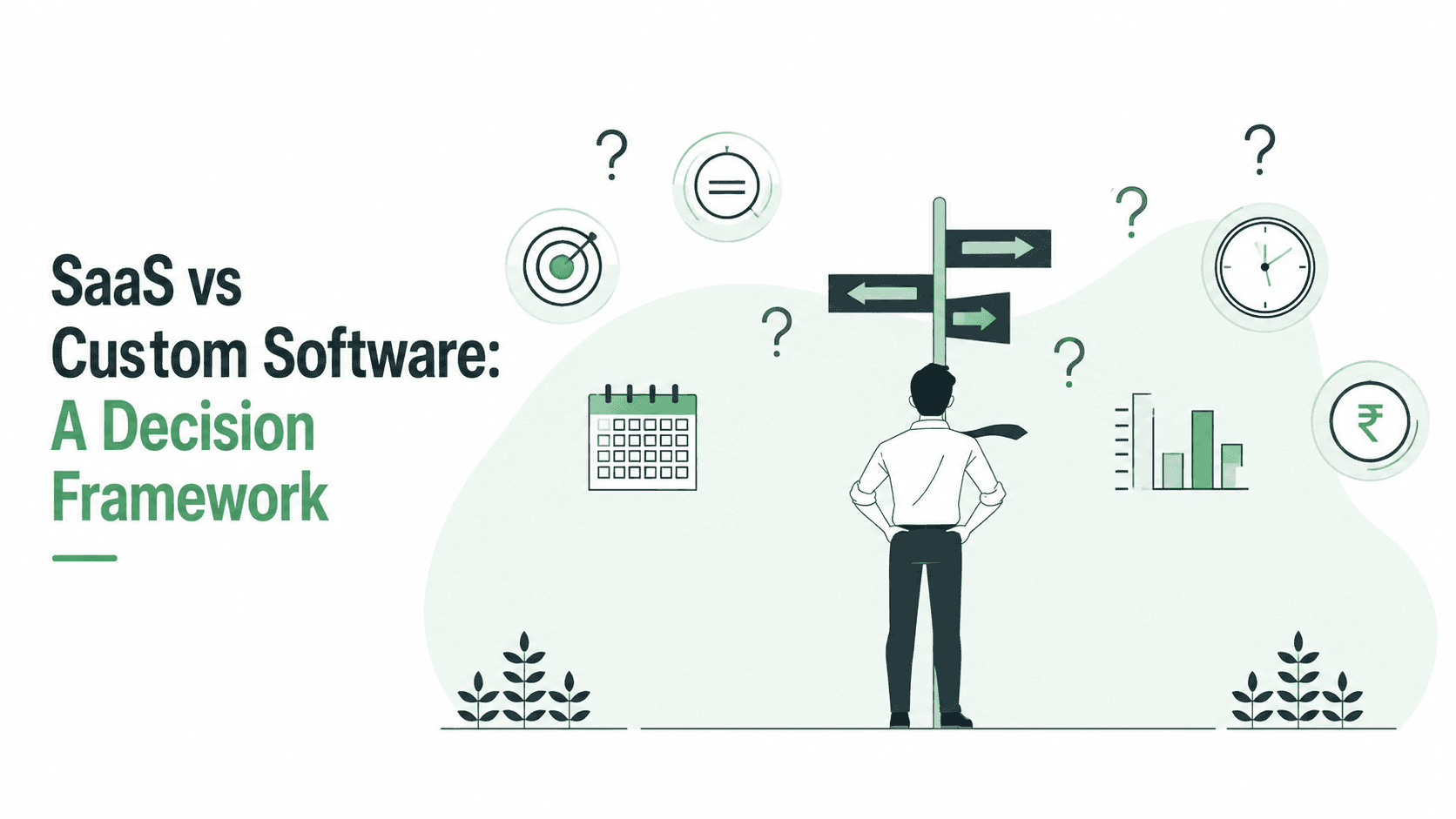
Choosing between SaaS and custom software often feels like a coin flip between two reasonable-sounding options, especially without a clear structure for actually thinking it through. Rather than comparing them in the abstract, a simple decision framework - working through the right questions in the right order - makes the choice far clearer for your specific situation. This blog walks through that framework, so you can decide with confidence instead of guesswork.
Question 1: Is Your Need Standard or Unique?
Start by honestly assessing how standard your requirements actually are.
- If your process closely resembles how most businesses in your category operate, SaaS is likely to fit well
- If your process is genuinely unique, with workflows or logic that don't map cleanly onto existing tools, custom software becomes worth serious consideration
Many businesses overestimate how unique their needs actually are - it's worth honestly testing this assumption before assuming custom is necessary.
Question 2: How Urgently Do You Need a Solution?
Timeline matters significantly in this decision.
- If you need something functional quickly, SaaS offers immediate implementation
- If you have the runway to invest in a longer development timeline, custom software becomes a realistic option
If there's genuine urgency, it may make sense to start with SaaS now and revisit custom software once there's less time pressure.
Question 3: What Does Your Budget Actually Support?
Budget considerations go beyond just the initial number.
- SaaS requires lower upfront investment but ongoing, recurring subscription costs
- Custom software requires higher upfront investment but no recurring per-user licensing fees
Consider not just what you can afford today, but what the total cost looks like over several years, particularly as your team or usage scales.
Question 4: How Much Will Your Usage Scale?
Growth trajectory significantly affects long-term cost and fit.
- If your team and usage will remain relatively small, SaaS pricing often stays manageable indefinitely
- If you expect significant growth, per-user SaaS costs can climb substantially, while custom software's cost structure doesn't scale the same way
This is often where the long-term math starts favoring custom software, even if SaaS looked cheaper initially.
Question 5: How Important Is Deep Integration?
Consider how connected this software needs to be with your other systems.
- If minimal integration is needed, SaaS's standalone functionality is often sufficient
- If deep, seamless integration with other custom software development your business relies on is essential, custom development offers far more flexibility
Question 6: Are There Security, Compliance, or Data Ownership Requirements?
Some businesses have requirements that standard SaaS platforms can't fully address.
- If your data handling needs fit within what established SaaS providers already support, this isn't a deciding factor
- If you have specific security, compliance, or data ownership requirements beyond what third-party platforms offer, custom software provides significantly more control
Question 7: Do You Have Access to a Reliable Development Partner?
Custom software is only a realistic option if you have - or can find - a trustworthy team to build and maintain it.
- Without an experienced, reliable development partner, custom software carries real execution risk
- With a strong partner in place, this risk becomes far more manageable
This question alone can shift the decision, since even the right underlying need for customization doesn't guarantee a successful outcome without solid execution.
Putting the Framework Together
Working through these questions in sequence tends to surface a clearer answer than debating "SaaS vs custom" as an abstract, all-or-nothing choice. In many cases, the honest answer is starting with SaaS now, while planning to revisit custom software once specific triggers - team growth, integration needs, or unique workflow demands - make the case clearer.
A Middle Path Many Businesses Choose
It's worth remembering this doesn't have to be a permanent, exclusive decision. Many businesses use SaaS for standard functions while investing in custom software specifically for the processes that genuinely differentiate how they operate - applying this framework to each function individually, rather than making one blanket decision for the entire business.
Where AI Automation Fits Into the Framework
Whichever path you choose, AI automation can layer in later - SaaS platforms typically offer generic automation features, while custom software allows automation to be built precisely around your specific workflows, a consideration worth factoring in in later, once your core platform decision is settled.
Frequently Asked Questions
Is this framework only useful for large businesses?
No. Businesses of any size can use this framework - the specific answers will differ, but the questions themselves apply broadly regardless of company size.
What if my answers point in different directions across different questions?
This is common. Weighing which factors matter most for your specific situation - often cost, timeline, or uniqueness of need - helps resolve conflicting signals.
Can I apply this framework to just one function of my business rather than the whole company?
Yes, and this is often the most practical approach - applying the framework separately to each software need rather than making one decision for everything at once.
Should I revisit this decision after initially choosing SaaS or custom?
Yes. As your business grows or needs change, it's worth periodically revisiting the framework, since the right answer for your current stage may shift over time.
Does needing custom software mean I have to abandon my SaaS tools entirely?
No. Many businesses use both simultaneously, choosing custom software for specific, differentiating needs while keeping SaaS tools for standard functions.
Ready to Work Through This Decision?
The right answer isn't SaaS or custom in the abstract - it's whichever fits your specific needs, budget, and growth trajectory. At Weboraz, we help you work through this framework honestly, even when the answer is to hold off on custom development for now. With a hybrid US-India team spanning software development, web development, and AI automation, we build the right solution once the framework points there.
Get a free software decision consultation from Weboraz and find out which path fits your business.
Frequently asked questions
No. Businesses of any size can use this framework - the specific answers will differ, but the questions themselves apply broadly regardless of company size.
This is common. Weighing which factors matter most for your specific situation - often cost, timeline, or uniqueness of need — helps resolve conflicting signals.
Yes, and this is often the most practical approach — applying the framework separately to each software need rather than making one decision for everything at once.
Yes. As your business grows or needs change, it's worth periodically revisiting the framework, since the right answer for your current stage may shift over time.
No. Many businesses use both simultaneously, choosing custom software for specific, differentiating needs while keeping SaaS tools for standard functions.
Related Articles
Need help applying this?
Our team can turn the ideas in this article into a clear plan and a polished build.
Contact Us