
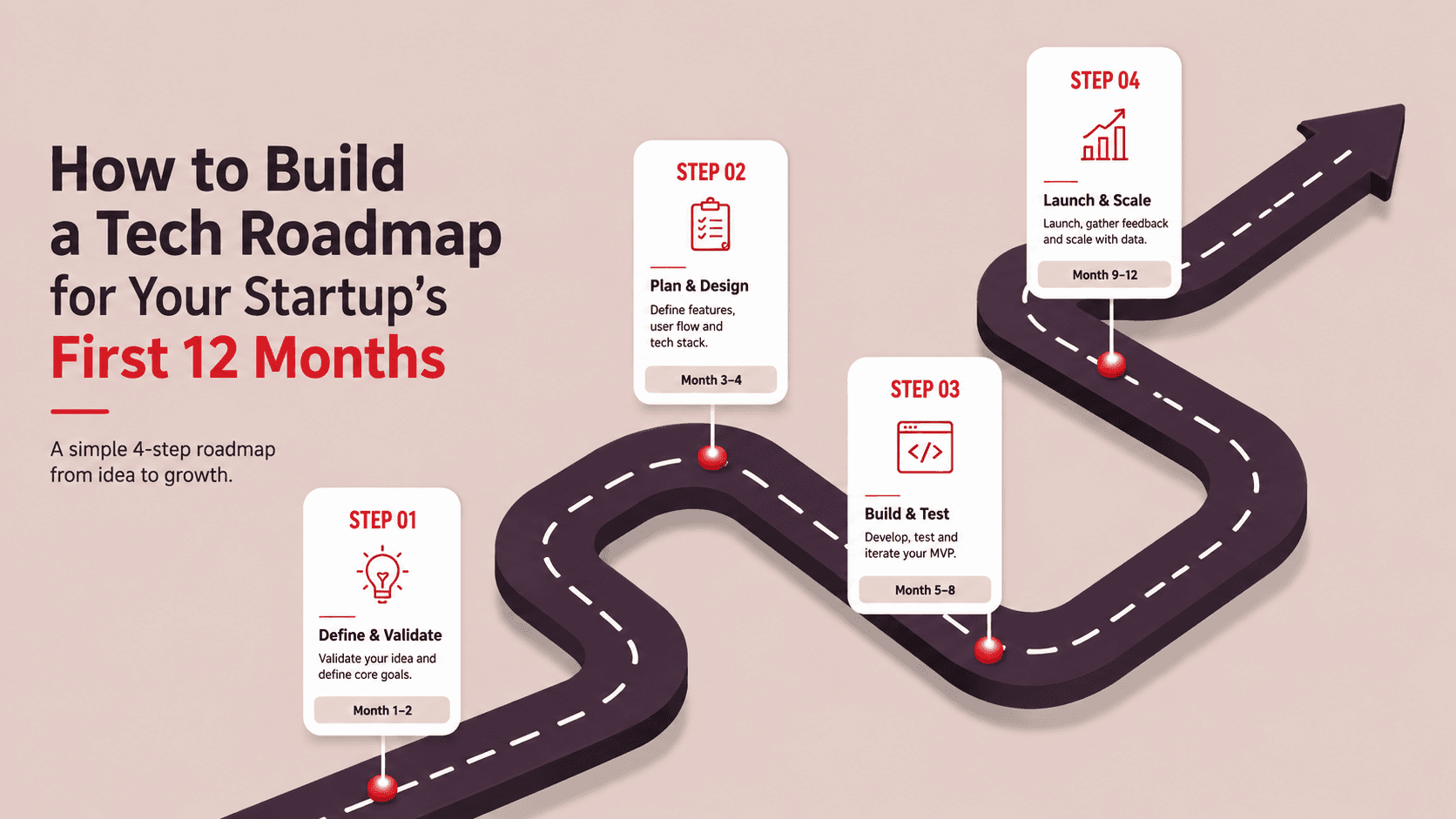
The first 12 months of a startup's technology decisions shape everything that follows, yet many founders approach this period reactively - building whatever seems urgent that week, rather than following a deliberate plan. A thoughtful tech roadmap doesn't mean predicting every detail a year out; it means sequencing decisions so each phase builds on real evidence from the last one. This blog walks through how to build a realistic 12-month tech roadmap for a startup's first year.
Why a Roadmap Matters More Than a Fixed Plan
A tech roadmap isn't about locking in exact features and dates a year in advance - startups change too quickly for that to hold. Instead, it's about having a clear sequence and set of priorities, so decisions are made deliberately rather than reactively, and so each phase has a clear purpose tied to what you're trying to learn or prove.
Months 1–3: Validate Before You Build Extensively
The first quarter should focus on confirming your core idea, not building out a full feature set.
- Validate the core problem and demand through direct conversations, landing pages, or manual testing
- Choose a lean, focused tech stack suited to your MVP, not your eventual scale
- Build the minimum functionality needed to test your core value proposition with real users
- Establish basic security and data handling practices from the very start
The goal in this phase isn't a polished product - it's evidence that your idea is worth building further.
Months 4–6: Build Your Focused MVP
With early validation in hand, this phase moves into building a genuine first version, still intentionally scoped.
- Define clear must-have functionality based on what you learned during validation
- Choose your development approach - native, hybrid, cross-platform, or web-based - based on actual user needs, not assumptions
- Prioritize a smooth, functional core experience over a broad feature set
- Set up basic analytics to track how real users actually interact with the product
This phase often benefits from experienced software development guidance, even at a lean stage, to avoid architectural decisions that become costly to unwind later.
Months 7–9: Launch and Learn From Real Usage
Once your MVP is ready, this phase centers on getting it in front of real users and paying close attention to what happens next.
- Launch to an initial group of users, even if not a full public release
- Monitor usage data, feedback, and support requests closely
- Fix critical bugs and usability issues surfaced by real-world use
- Begin identifying which features are genuinely valuable versus which were assumptions that didn't hold up
This is often the most information-rich phase of the entire year — real usage tends to reveal priorities no amount of planning could have predicted.
Months 10–12: Prioritize and Scale What's Working
With real usage data in hand, the final quarter shifts toward deliberate expansion, guided by evidence rather than guesswork.
- Prioritize new features based on what users are actually requesting or struggling with
- Address any technical debt or shortcuts taken during the MVP phase that are now limiting growth
- Begin planning infrastructure needs if usage is scaling meaningfully
- Evaluate whether it's time to introduce additional capabilities, such as AI automation, based on patterns you've now observed in real usage
Weaving in Team and Partner Decisions Throughout the Year
Your roadmap should also account for how you're getting the work done, not just what gets built. Early phases might rely on a freelancer or small development partner, while later phases - once technical needs become more consistent - may justify evaluating an agency relationship or eventual in-house hires.
Building Flexibility Into the Roadmap From the Start
A good roadmap plans for revision, not rigid adherence. Building on a foundation that can evolve - rather than architecture that locks you into early assumptions - matters more in year one than getting every long-term detail exactly right upfront.
Common Mistakes That Derail a First-Year Roadmap
Some patterns tend to throw a first-year roadmap off track:
- Skipping validation and jumping straight into extensive building
- Overbuilding features before there's evidence they're needed
- Ignoring real usage data in favor of the founder's original assumptions
- Treating the roadmap as fixed rather than something to revisit as evidence comes in
Why This Roadmap Structure Applies Broadly
Whether your startup is building a web product, a mobile app development project, or something involving significant AI automation from the start, this same validate-build-launch-scale sequence applies - the specific technology changes, but the underlying logic of the roadmap doesn't.
Frequently Asked Questions
Should a startup's tech roadmap be fixed for the full 12 months?
No. The roadmap should provide sequence and priorities, but stay flexible enough to adjust based on what real user data reveals throughout the year.
Is it a mistake to build extensive features in the first three months?
Generally yes. The first quarter should focus on validating the core idea before investing heavily in building out a broader feature set.
When should a startup introduce AI automation into its roadmap?
Most often in the later phases, once real usage data reveals where automation would genuinely add value, rather than building it in from day one based on assumptions.
How much of the roadmap should be planned before development even starts?
Enough to define priorities and sequencing clearly, but not so much detail that it becomes a rigid plan disconnected from real user feedback once building begins.
Does this roadmap structure apply to non-technical startups too?
The validate-build-launch-scale sequence applies broadly to most startups building any kind of product, even if the specific technology involved differs significantly.
Ready to Map Out Your First 12 Months?
A strong tech roadmap doesn't predict everything - it sequences decisions so each phase builds on real evidence, not assumptions. At Weboraz, we help founders build roadmaps grounded in validation and actual usage, not a rigid plan set in stone on day one. With a hybrid US-India team spanning software development, web development, mobile app development, and AI automation, we help you build the right thing at the right time.
Get a free startup roadmap consultation from Weboraz and find out what your first 12 months should actually look like.
Frequently asked questions
No. The roadmap should provide sequence and priorities, but stay flexible enough to adjust based on what real user data reveals throughout the year.
Generally yes. The first quarter should focus on validating the core idea before investing heavily in building out a broader feature set.
Most often in the later phases, once real usage data reveals where automation would genuinely add value, rather than building it in from day one based on assumptions.
Enough to define priorities and sequencing clearly, but not so much detail that it becomes a rigid plan disconnected from real user feedback once building begins.
The validate-build-launch-scale sequence applies broadly to most startups building any kind of product, even if the specific technology involved differs significantly.
Related Articles

Need help applying this?
Our team can turn the ideas in this article into a clear plan and a polished build.
Contact Us