
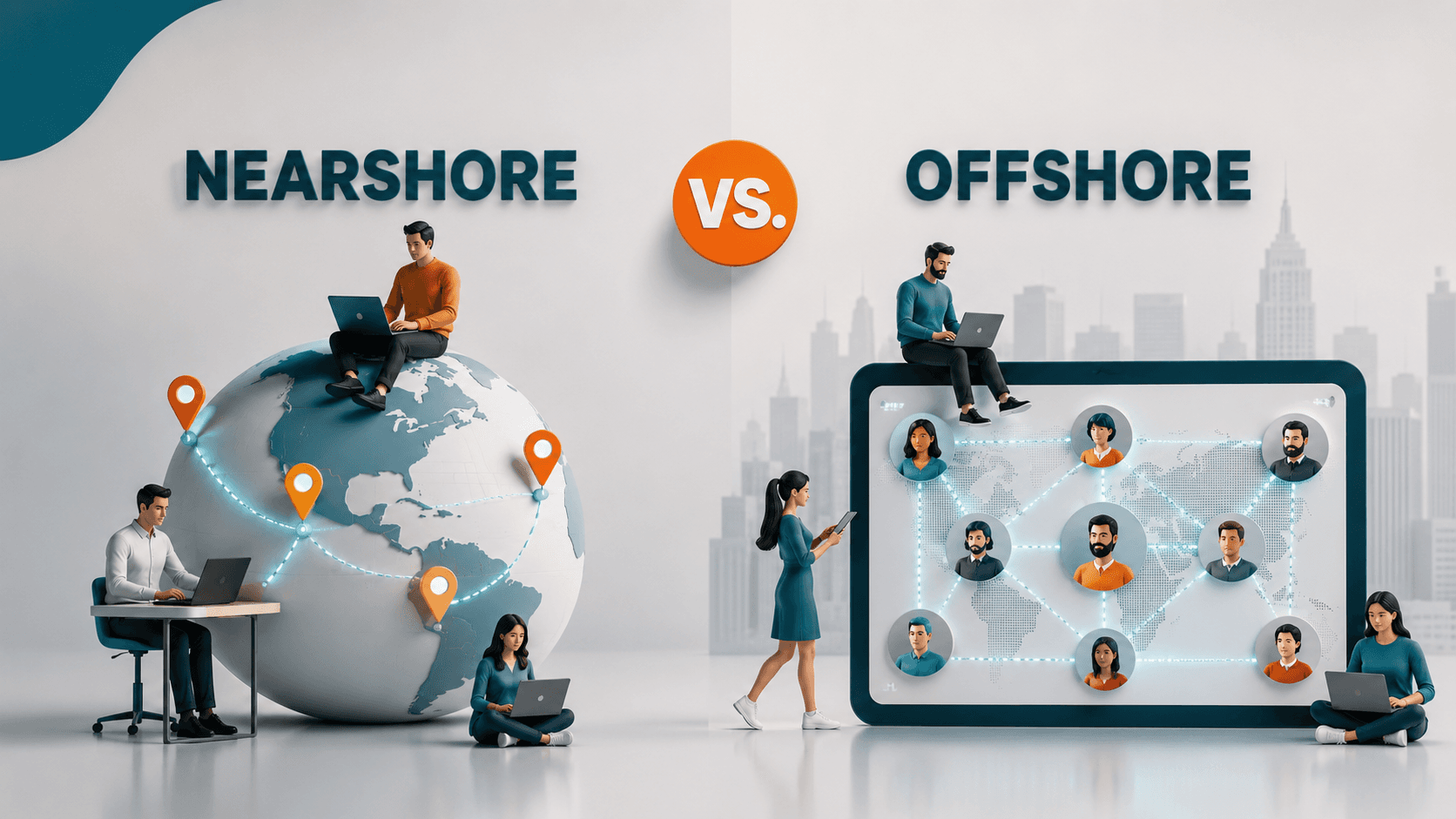
Founders and CTOs comparing outsourcing regions usually frame it as a single tradeoff: pay more for time zone overlap and cultural closeness, or pay less and accept more coordination friction. That framing isn't wrong, but it's incomplete - the right answer depends heavily on your team's actual working style, budget, and how much real-time collaboration your specific project genuinely needs. This blog breaks down nearshore and offshore software development honestly, so you can evaluate which model actually fits before you start vetting specific vendors.
What "Nearshore" Actually Means
Nearshore development means partnering with a team in a nearby or reasonably close time zone, typically within a few hours of your own. For US-based businesses, this often means Latin America; for UK or European businesses, it might mean Eastern Europe. The core appeal is real-time collaboration without the premium of hiring locally.
Advantages:
- Significant working-hour overlap, supporting real-time meetings and quick back-and-forth
- Often closer cultural and business communication norms
- Easier travel for in-person collaboration when needed
- Generally faster response times during your own working hours
Tradeoffs:
- Cost savings are real but typically more modest than offshore options
- Smaller nearshore talent pools in some regions can mean more limited specialization
- Rates have risen in popular nearshore hubs as demand has grown
What "Offshore" Actually Means
Offshore development means partnering with a team in a distant region, often on the opposite side of the globe, where labor costs are typically much lower. This is the classic outsourcing model many businesses associate with terms like cost efficiency and scale.
Advantages:
- Significantly lower cost per hour compared to nearshore or local hiring
- Access to large, mature talent pools in established offshore hubs
- Ability to scale a team meaningfully without a proportional cost increase
Tradeoffs:
- Limited or no working-hour overlap, which can slow real-time collaboration
- Communication requires more deliberate structure to avoid misunderstandings
- Time zone gaps can extend feedback loops if not managed carefully
Why This Isn't Really a Binary Choice
The nearshore-vs-offshore framing assumes you have to pick one model and live entirely within its tradeoffs. In practice, the two models solve different problems - nearshore solves for collaboration speed, offshore solves for cost efficiency and scale - and businesses increasingly structure teams that capture both, rather than accepting the full tradeoff of either extreme.
How a Hybrid Model Changes the Calculation
A well-structured hybrid model - combining elements of both nearshore-style collaboration and offshore-style cost efficiency within one integrated team - addresses the core weakness of each approach individually:
- Overlapping working hours are deliberately built in, even across a larger time zone gap, so real-time collaboration remains possible
- Cost efficiency approaches offshore-level savings rather than nearshore's more modest discount
- Shared processes, documentation standards, and communication practices apply consistently across the team, rather than treating distant team members as a separate, less-integrated group
This is meaningfully different from simply "using an offshore vendor" - the structure itself is designed to minimize the tradeoffs that typically come with distance.
What to Evaluate Beyond Region Alone
Regardless of which model you're considering, region alone doesn't determine outcome quality. It's worth evaluating:
- Communication structure: Are there deliberate overlapping hours, or is asynchronous communication the only option?
- Process consistency: Does the team follow shared coding standards and quality practices, or does location create a two-tier system?
- Project management: Is there a clear, consistent point of contact, or does communication route through a rotating cast of unfamiliar people?
- Technical depth: Does the team have genuine experience in your specific technology stack, not just general availability?
Matching the Model to Your Project Type
- Fast-moving, iterative projects requiring frequent real-time feedback often lean toward nearshore or a hybrid model with strong overlap
- Well-defined, larger-scope builds with clear requirements can work well fully offshore, since less real-time coordination is required
- Startups balancing tight budgets with the need for responsiveness often find a hybrid model delivers the best combination of both, rather than forcing a choice between speed and cost
Why Cost Comparisons Need More Context Than Hourly Rate
Comparing nearshore and offshore purely on hourly rate misses important context. A lower offshore rate can become more expensive overall if communication gaps cause rework or delays, while a nearshore rate's premium may be worth it for projects where speed of iteration directly affects business outcomes. The real comparison is total project cost and outcome quality, not just the number on a rate card.
Where This Fits Into Your Broader Development Decisions
Choosing an outsourcing model is only one part of a larger decision that also includes whether Custom Software Development is the right approach for your project at all, and how the resulting team integrates with AI Automation or Mobile App Development work your roadmap may eventually require.
Making the Decision for Your Business
Rather than starting with "nearshore or offshore," it helps to start with a clearer question: how much real-time collaboration does this specific project genuinely need, and how much can reasonably happen asynchronously? That answer, combined with your budget constraints, points toward the model - or hybrid structure - that actually fits, rather than defaulting to whichever region a vendor happens to pitch first.
Related Services
- Custom Software Development - delivered through a structured, hybrid team model built for both collaboration and cost efficiency
- Web Development - built by a team with consistent process and communication standards regardless of project scope
- Mobile App Development - supported by overlapping working hours for real-time iteration where it matters
- AI Automation - integrated into projects without the coordination gaps a fully offshore-only model can introduce
Related Blogs
- US-India Hybrid Development Model: How It Cuts Costs Without Cutting Quality
- Outsourcing Development: Risks, Rewards, and How to Do It Right
- Choosing Between a Freelancer, Agency, or In-House Team for Your Project
Frequently Asked Questions
Is nearshore development always more expensive than offshore?
Generally yes, since nearshore regions typically have higher labor costs than distant offshore hubs, though the gap has narrowed in some popular nearshore markets as demand has grown.
Can a hybrid model really deliver both cost savings and real-time collaboration?
Yes, when structured deliberately - with overlapping working hours, shared processes, and consistent communication standards applied across the whole team, rather than treating it as a simple cost-driven offshore arrangement.
Which model is better for startups: nearshore or offshore?
It depends on how much real-time collaboration the project genuinely needs. Startups needing frequent iteration often lean nearshore or hybrid, while those with well-defined, larger-scope builds can work well fully offshore.
Does offshore development always mean worse communication?
Not necessarily, but it requires more deliberate communication structure - overlapping hours where possible, clear documentation, and consistent points of contact - to avoid the gaps that unmanaged offshore engagements are known for.
How do I evaluate an outsourcing partner beyond just their region?
Look at communication structure, process consistency across team members, project management clarity, and genuine technical depth in your specific stack, rather than relying on region alone as a quality signal.
Weighing Nearshore, Offshore, or Something in Between?
Most founders don't actually need to choose between cost and collaboration - they need a team structured to minimize that tradeoff in the first place. Weboraz operates as a hybrid US-India team with deliberate overlapping hours and shared standards, built to capture the collaboration benefits of nearshore alongside offshore-level cost efficiency. Contact Us to talk through which model, or combination, actually fits how your team works.
Frequently asked questions
Generally yes, since nearshore regions typically have higher labor costs than distant offshore hubs, though the gap has narrowed in some popular nearshore markets as demand has grown.
Yes, when structured deliberately - with overlapping working hours, shared processes, and consistent communication standards applied across the whole team, rather than treating it as a simple cost-driven offshore arrangement.
It depends on how much real-time collaboration the project genuinely needs. Startups needing frequent iteration often lean nearshore or hybrid, while those with well-defined, larger-scope builds can work well fully offshore.
Not necessarily, but it requires more deliberate communication structure - overlapping hours where possible, clear documentation, and consistent points of contact - to avoid the gaps that unmanaged offshore engagements are known for.
Look at communication structure, process consistency across team members, project management clarity, and genuine technical depth in your specific stack, rather than relying on region alone as a quality signal.
Related Articles

Insights
E-Signature and Contract Management Software Development for Professional Services Firms
Read More
Insights
Finance and Accounting Software Development: Secure Dashboards, Reporting, and Client Workflows
Read More
Insights
Best Custom Software Development Companies for Manufacturing Businesses
Read MoreNeed help applying this?
Our team can turn the ideas in this article into a clear plan and a polished build.
Contact Us