
Once a scaling company decides it needs outside development help, the next question usually isn't "should we outsource" - it's "what kind of outsourcing." Staff augmentation and full outsourcing both bring in external developers, but they place responsibility, oversight, and risk in genuinely different places. Getting this choice wrong doesn't necessarily mean a bad vendor - it often means a mismatch between the model and how your company actually needs to work. This blog breaks down the real differences, so you can choose the engagement model that fits your situation, not just the one that sounds more familiar.
What Staff Augmentation Actually Means
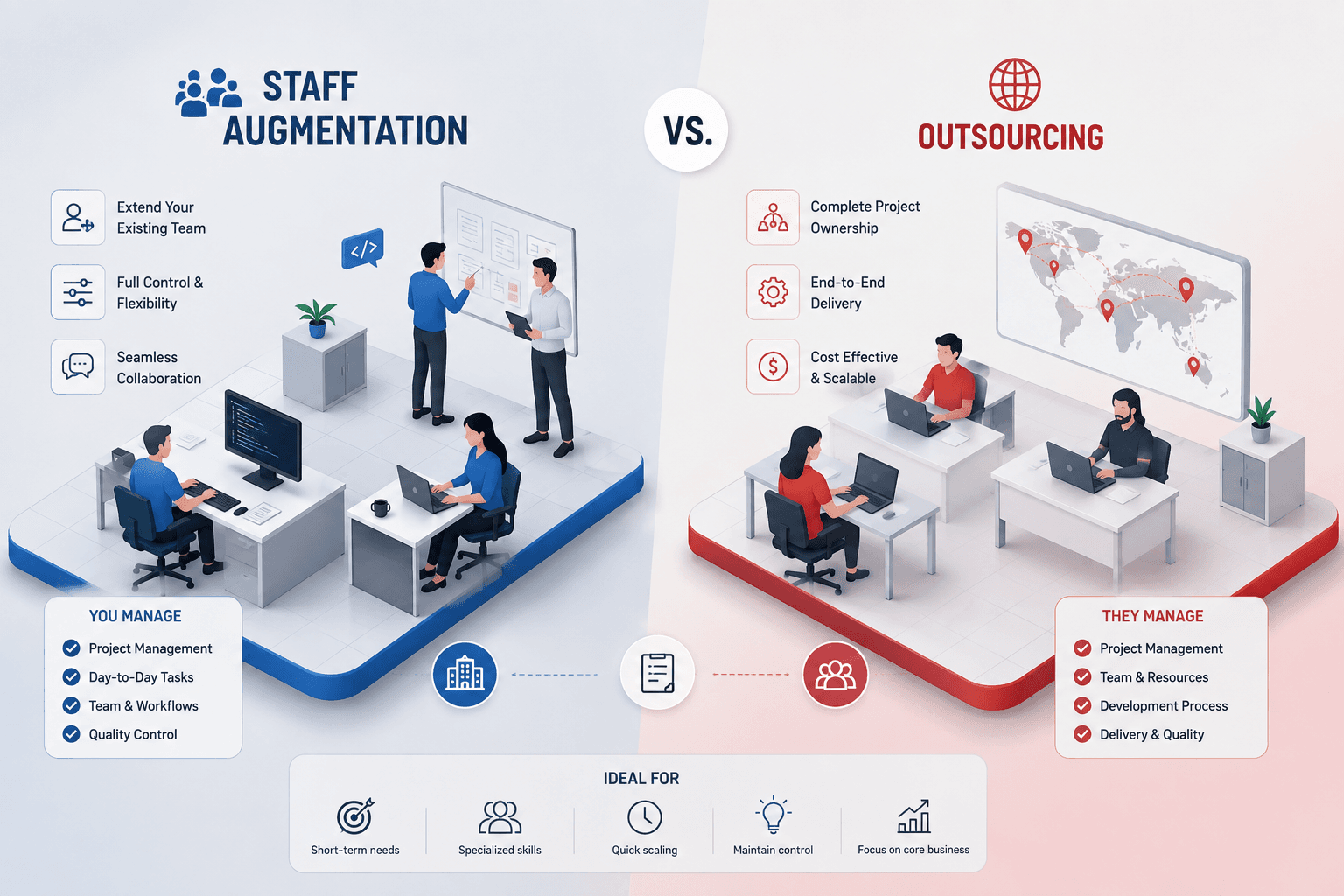
Staff augmentation means adding individual external developers directly into your existing team and internal processes. They work within your tools, your sprint cadence, and your management structure, functioning essentially as embedded team members rather than an independent unit.
Key characteristics:
- You retain day-to-day management, priorities, and technical direction
- Augmented developers follow your existing processes and tools
- Typically billed on a time-and-materials basis
- Well suited to filling specific skill gaps or capacity shortages within a team you already lead
What Full Outsourcing Actually Means
Full outsourcing - often structured as a dedicated team or project-based engagement - means handing a defined scope of work to an external team that operates largely independently, using their own processes, management, and quality standards, while you set direction and review outcomes.
Key characteristics:
- The vendor provides project management, technical leadership, and delivery oversight
- The team operates using its own established methodology, not necessarily yours
- Often billed as a predictable monthly rate or fixed-price arrangement tied to deliverables
- Well suited when you want an outcome delivered without managing the day-to-day execution yourself
The Core Difference: Where Control and Responsibility Sit
The clearest way to distinguish the two models is by asking who's actually driving day-to-day decisions. With staff augmentation, that's still you - the developers are extra hands, but your team retains architectural and management responsibility. With full outsourcing, that responsibility shifts largely to the vendor, in exchange for less day-to-day involvement required from your side.
Neither is inherently better - the right choice depends on whether your organization has the internal leadership bandwidth to direct additional developers, or whether you'd rather hand off both execution and management for a defined outcome.
When Staff Augmentation Tends to Fit Better
Staff augmentation tends to be the stronger choice when:
- You have strong internal technical leadership and a clear, well-managed backlog
- You need to fill a specific skill gap or temporary capacity shortage, not build an entire new capability
- Keeping full architectural and process control internally matters to your organization
- You want the flexibility to scale headcount up or down without a longer-term vendor commitment
When Full Outsourcing Tends to Fit Better
Full outsourcing tends to be the stronger choice when:
- You need a defined outcome delivered without the internal bandwidth to manage day-to-day execution
- Your team lacks specific expertise your organization doesn't plan to build internally long-term
- Project scope is reasonably well-defined, supporting a predictable engagement structure
- You want a single accountable partner responsible for both delivery and quality, not just headcount
Cost Comparison: More Than Just the Rate
Staff augmentation's time-and-materials pricing can look more cost-efficient on paper, but it doesn't account for the internal management time required to direct additional developers effectively. Full outsourcing's monthly or fixed-price structure often includes project management and quality oversight built into the cost - meaning the "cheaper" model on paper isn't always cheaper once your team's management overhead is factored in.
Risk Considerations for Each Model
Each model concentrates risk differently, not eliminates it:
- Staff augmentation keeps institutional knowledge and data closer to your organization, but creates dependency risk if augmented developers leave, since much of the process knowledge may live with them individually
- Full outsourcing transfers execution risk to the vendor for a defined scope, but requires careful governance around data access, intellectual property, and long-term dependency on that specific vendor relationship
How Scaling Companies Often Use Both Models
Many growing companies don't choose exclusively one model - they use staff augmentation to fill specific internal capacity gaps while relying on full outsourcing, through Custom Software Development, for defined, larger-scope projects that don't require ongoing internal management. The right mix often shifts as the company's internal technical leadership and priorities evolve.
Evaluating a Partner for Either Model
Regardless of which model you choose, evaluate a potential partner on:
- Relevant experience specific to your technology stack and project type, not just general availability
- Clear communication practices and consistent points of contact
- Transparent processes for either augmented developers or a fully managed team
- Honest guidance on which model actually fits your situation, rather than defaulting to whichever they happen to sell
Making the Decision for Your Company
Rather than starting with "augmentation or outsourcing" in the abstract, start with an honest assessment of your internal leadership bandwidth and how well-defined your project scope actually is. Strong internal leadership with a clear backlog points toward augmentation; a well-defined outcome without the bandwidth to manage delivery points toward full outsourcing.
Related Services
- Custom Software Development - delivered as either augmented team members or a fully managed dedicated team
- Web Development - supported through both engagement models depending on your internal capacity
- Mobile App Development - scoped as a fully outsourced project or supported through augmented specialists
- AI Automation - often brought in through augmentation when internal teams need specific AI expertise short-term
Related Blogs
- Choosing Between a Freelancer, Agency, or In-House Team for Your Project
- In-House Development vs Outsourced Development: Full Comparison
- Outsourcing Development: Risks, Rewards, and How to Do It Right
Frequently Asked Questions
What's the main difference between staff augmentation and full outsourcing?
Staff augmentation adds individual developers under your internal management and processes, while full outsourcing hands a defined scope to an external team that manages its own delivery and quality.
Is staff augmentation cheaper than full outsourcing?
It can look cheaper on a time-and-materials basis, but full outsourcing's pricing often includes project management and oversight, so the actual cost comparison depends on your internal management overhead as well.
Can a scaling company use both models at the same time?
Yes, and many do - using augmentation to fill specific internal gaps while outsourcing larger, well-defined projects that don't require ongoing internal management.
Which model is better for a company without strong internal technical leadership?
Full outsourcing tends to fit better in this situation, since it shifts both execution and management responsibility to the vendor, rather than requiring internal leadership to direct additional developers.
What's the biggest risk with staff augmentation specifically?
Dependency risk is a key concern, since process knowledge can be concentrated in individual augmented developers who may leave, rather than being embedded in a broader vendor organization.
Deciding Between Augmentation and Full Outsourcing?
The right model depends less on which sounds more "serious" and more on how much internal bandwidth you actually have to manage additional developers. Weboraz supports scaling companies through both staff augmentation and fully managed outsourced teams, and can help you assess honestly which fits your current stage. Contact Us to talk through which engagement model makes sense for your team.
Frequently asked questions
Staff augmentation adds individual developers under your internal management and processes, while full outsourcing hands a defined scope to an external team that manages its own delivery and quality.
It can look cheaper on a time-and-materials basis, but full outsourcing's pricing often includes project management and oversight, so the actual cost comparison depends on your internal management overhead as well.
Yes, and many do - using augmentation to fill specific internal gaps while outsourcing larger, well-defined projects that don't require ongoing internal management.
Full outsourcing tends to fit better in this situation, since it shifts both execution and management responsibility to the vendor, rather than requiring internal leadership to direct additional developers.
Dependency risk is a key concern, since process knowledge can be concentrated in individual augmented developers who may leave, rather than being embedded in a broader vendor organization.
Related Articles

Insights
E-Signature and Contract Management Software Development for Professional Services Firms
Read More
Insights
Finance and Accounting Software Development: Secure Dashboards, Reporting, and Client Workflows
Read More
Insights
Best Custom Software Development Companies for Manufacturing Businesses
Read MoreNeed help applying this?
Our team can turn the ideas in this article into a clear plan and a polished build.
Contact Us