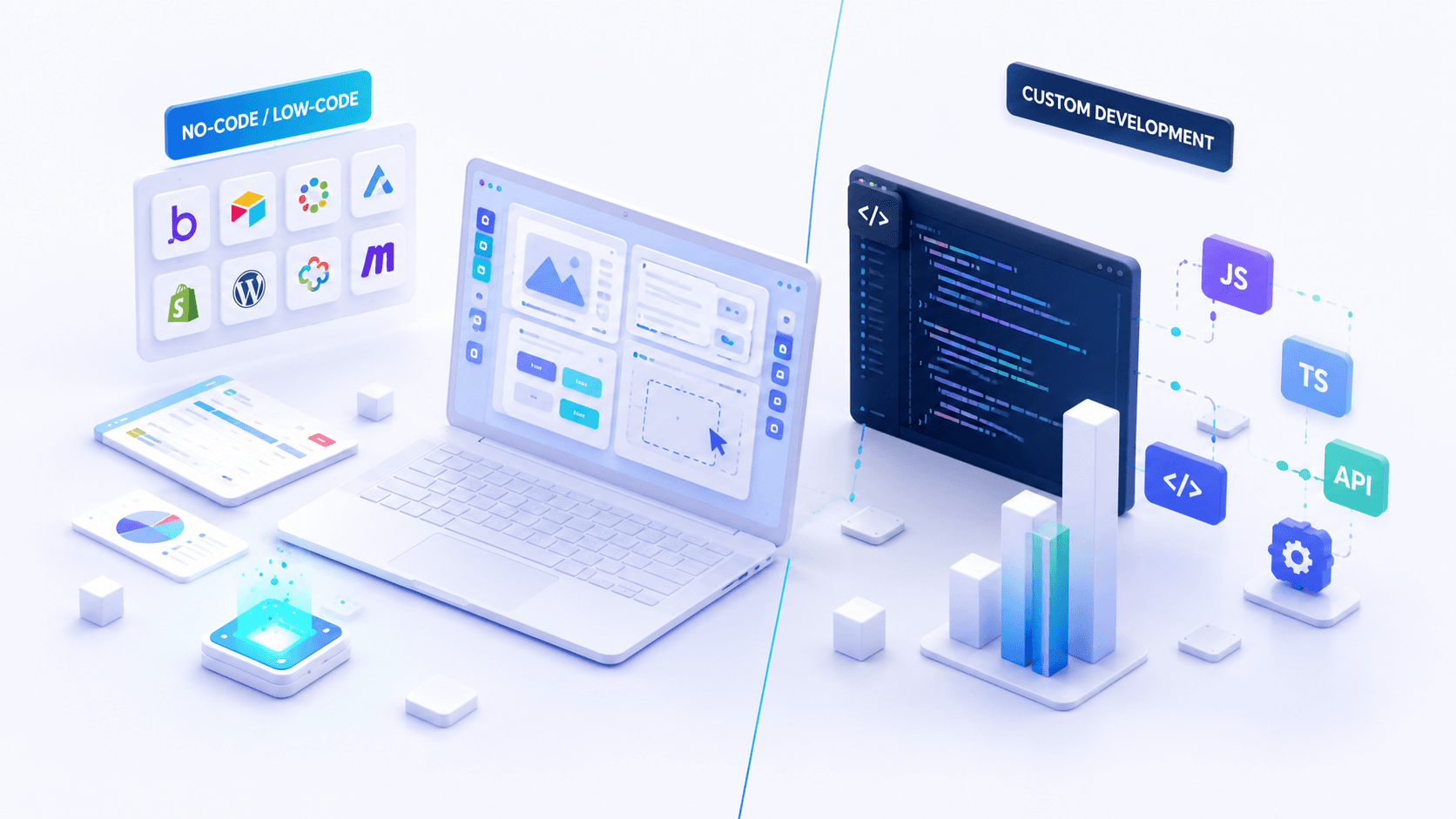
Tools like Bubble, Airtable, and Zapier have genuinely changed how founders validate ideas — what used to require a development team and months of runway can now get built and launched in weeks. But plenty of founders eventually hit a point where the same tool that made launch possible starts actively limiting growth: performance ceilings, workflow constraints, or a monthly bill that's climbed well past what it should cost to run the business. This blog offers a practical framework for deciding when a no-code tool is still the right choice, and when it's time to move to custom software.
Why No-Code Is the Right Starting Point for Most Founders
Before getting into when to leave no-code behind, it's worth being direct about why it's often the correct first choice:
- Dramatically faster time to launch than building custom software from scratch
- Lower upfront cost, letting founders validate an idea before committing significant capital
- No need for a development team just to test whether an idea has real demand
- Flexibility to iterate quickly based on early user feedback without a formal development cycle
For validating a concept, no-code tools are frequently the smarter choice, not a compromise.
The Signals That You're Starting to Outgrow No-Code
The transition point isn't always obvious in the moment, but a few patterns tend to show up consistently:
- Performance degrades as usage grows — the platform starts feeling noticeably slower as your data volume or user count increases
- Workflows require constant workarounds — you're building increasingly convoluted logic to approximate functionality the platform wasn't designed to support
- Costs are climbing faster than revenue justifies — usage-based or per-seat pricing scales in a way that starts eating meaningfully into margins
- Integration limitations are blocking real functionality — you need to connect to systems or build logic the platform's native integrations simply can't handle
- You're paying a "no-code tax" in developer time — engineers spend significant time working around platform constraints rather than building features
One of these signals alone isn't necessarily a reason to move. Several appearing together, and getting worse over time, usually is.
A Practical Framework: Four Questions to Ask
Rather than deciding on gut feeling, work through these questions in order:
1. Is the limitation about scale, or about capability?
Performance issues at higher volume are often a scale problem no-code platforms weren't built to handle well. Missing functionality entirely is a capability problem. Both point toward custom development, but capability gaps tend to be more urgent, since no amount of optimization fixes something the platform simply can't do.
2. What's the actual cost trajectory, not just the current bill?
Usage-based no-code pricing often scales in ways that aren't obvious until you project it forward. Compare your current monthly cost against a realistic projection at 2x and 5x your current usage, and weigh that against what custom development and its lower ongoing costs would look like at the same scale.
3. How core is this system to your actual differentiation?
A no-code internal tool your team uses for scheduling is a very different decision than a no-code platform running your core customer-facing product. The more central a system is to what actually makes your business different, the stronger the case for owning it outright through custom development.
4. Do you have the technical leadership to manage a custom build?
Moving to custom software requires either strong internal technical leadership or a trustworthy development partner who can guide the transition. Without either, the transition itself carries real execution risk that's worth weighing honestly.
What Custom Software Solves That No-Code Structurally Can't
Through dedicated Custom Software Development, a rebuilt system can address the specific limitations that tend to push founders toward this decision:
- Architecture designed for your actual scale, not retrofitted onto a platform with inherent ceilings
- Business logic built exactly around your workflows, not approximated through platform workarounds
- Full ownership of the codebase and data, without dependency on a third-party platform's roadmap or pricing changes
- Integration flexibility limited only by what's technically possible, not by what a no-code platform's connectors support
Migrating From No-Code Without Starting From Zero
Moving away from a no-code tool doesn't mean discarding everything you've learned building on it. The validated workflows, user feedback, and product decisions made during the no-code phase are genuinely valuable inputs into a custom rebuild — the goal is preserving what you've learned about what actually works, while rebuilding the underlying architecture to support where the business is actually headed.
A Middle Path: Custom Where It Matters Most
Not every part of the business needs to move off no-code simultaneously. Many growing companies keep no-code or low-code tools for internal, lower-stakes workflows, while investing in custom development specifically for the core product or the systems that genuinely differentiate the business — applying this framework function by function, rather than making one blanket decision.
Where AI Fits Into This Decision
Some no-code platforms now offer AI-assisted features, but through dedicated AI Automation, custom-built AI features can be tuned precisely to your specific product and data, rather than relying on a generic implementation shared across every business on that no-code platform.
Making the Transition Timing Decision
There's rarely a single "right moment" to move from no-code to custom software — but waiting until the platform's limitations are actively costing revenue or blocking growth tends to make the transition more urgent and disruptive than planning for it proactively once the signals above start appearing consistently.
Related Services
- Custom Software Development - rebuilding your product architecture around your actual scale and workflows
- SaaS Product Development - relevant for founders transitioning a no-code product into a scalable SaaS platform
- AI Automation - building AI features tuned to your specific product, beyond generic no-code AI add-ons
- API Integration - connecting systems in ways no-code native integrations often can't support
Related Blogs
- Software Integration 101: Making Your Tools Work Together
- Enterprise Software vs SaaS: Making the Right Choice for Scale
Frequently Asked Questions
How do I know if my no-code platform's cost is actually a problem or just feels expensive?
Project your current usage-based cost forward at 2x and 5x your current volume, then compare that trajectory against what custom development and its ongoing costs would look like at the same scale.
Is it always worth moving to custom software once a no-code tool shows limitations?
Not necessarily. Weigh whether the limitation affects your core differentiating product versus a lower-stakes internal tool - the more central the system, the stronger the case for custom development.
Can I preserve what I learned building on a no-code platform when moving to custom software?
Yes. Validated workflows, user feedback, and product decisions made during the no-code phase remain valuable inputs into a custom rebuild, even though the underlying architecture changes.
Do I need to move everything off no-code at once?
No. Many businesses keep no-code tools for lower-stakes internal workflows while moving only their core, differentiating systems to custom development.
What's the biggest risk in delaying a move from no-code to custom software?
Waiting until platform limitations are actively costing revenue or blocking growth tends to make the eventual transition more urgent and disruptive than planning for it once early warning signals appear.
Not Sure If You've Outgrown Your No-Code Tool?
If workarounds are piling up, costs are climbing faster than revenue, or your platform simply can't do what your product now needs, that's usually worth a real evaluation, not a gut reaction. Weboraz helps founders work through this decision honestly, including migrating validated no-code products into custom-built systems when the numbers actually support it. Contact Us to talk through whether it's time to move beyond your current platform.
Frequently asked questions
Project your current usage-based cost forward at 2x and 5x your current volume, then compare that trajectory against what custom development and its ongoing costs would look like at the same scale.
Not necessarily. Weigh whether the limitation affects your core differentiating product versus a lower-stakes internal tool — the more central the system, the stronger the case for custom development.
Yes. Validated workflows, user feedback, and product decisions made during the no-code phase remain valuable inputs into a custom rebuild, even though the underlying architecture changes.
No. Many businesses keep no-code tools for lower-stakes internal workflows while moving only their core, differentiating systems to custom development.
Waiting until platform limitations are actively costing revenue or blocking growth tends to make the eventual transition more urgent and disruptive than planning for it once early warning signals appear.
Related Articles


Need help applying this?
Our team can turn the ideas in this article into a clear plan and a polished build.
Contact Us