
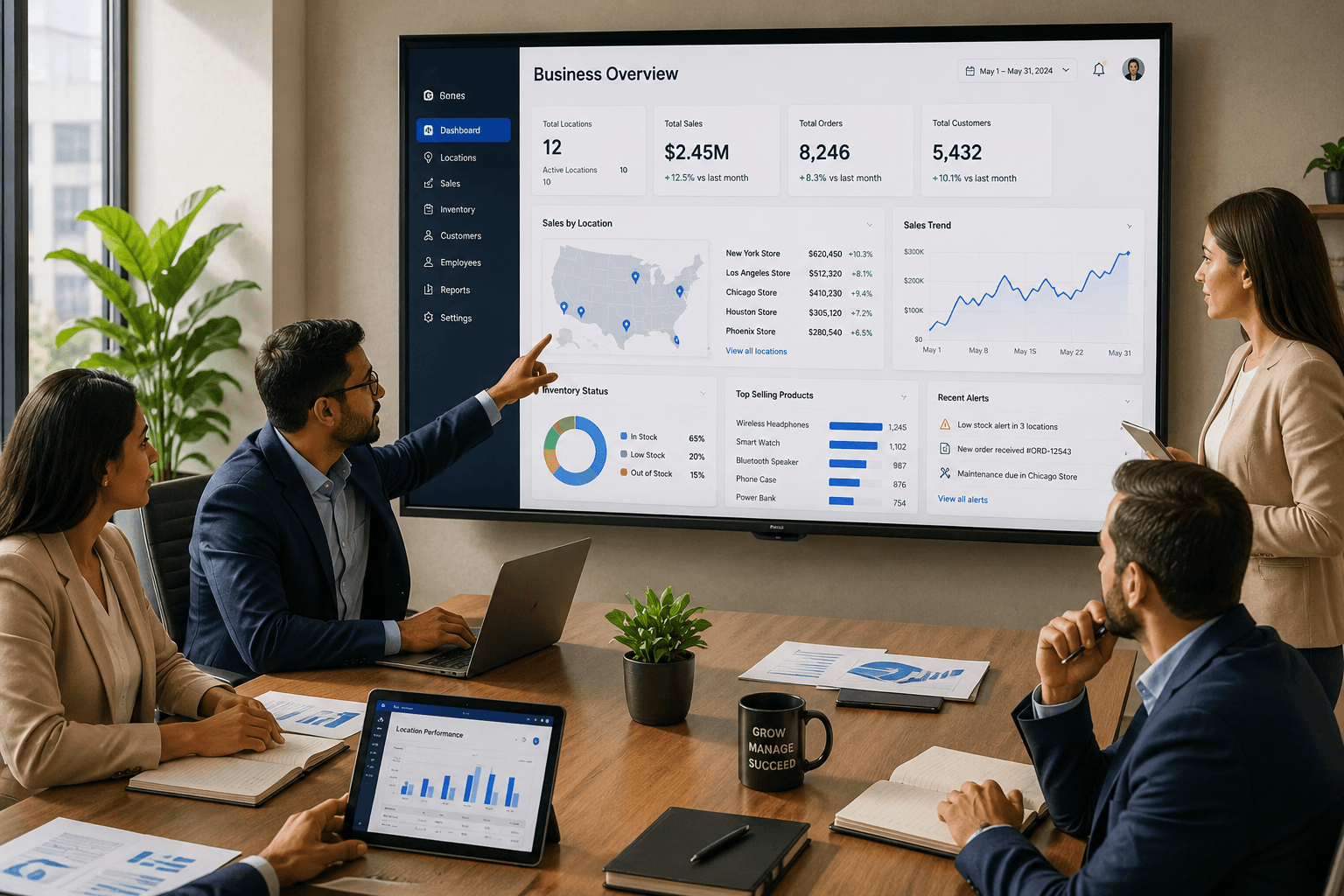
Every multi-location business eventually hits the same wall: each branch or location has its own way of tracking inventory, reporting sales, and handling day-to-day operations, and getting a single, accurate picture across all of them means manually reconciling data that was never designed to be combined. This bottleneck tends to grow worse with every new location added, not better. This blog looks at what custom multi-location business management software actually involves, and why growing franchises and multi-branch operations increasingly need centralized software built specifically around that structure.
Why Single-Location Tools Break Down Across Multiple Branches
Most software - POS systems, inventory tools, scheduling platforms - is built with a single-location mental model, even when vendors market "multi-location support" as a feature. Common friction points as a business expands to multiple sites include:
- Inventory tracked separately at each location, with no accurate real-time view of stock across the whole business
- Reporting that requires manually combining exports from each branch into a single spreadsheet
- Inconsistent processes between locations, since each branch manager often adapts tools independently
- No centralized visibility into performance comparisons across locations without significant manual effort
What Multi-Location Management Software Actually Needs to Do
At its core, centralized operations software needs to unify data and processes across every location while still respecting what's genuinely local, typically including:
- Real-time inventory visibility across all locations, including transfers between branches
- Consolidated financial and operational reporting that rolls up individual location data accurately
- Standardized processes and workflows, with the flexibility to accommodate genuine local variation where needed
- Centralized oversight for franchisors or corporate leadership, alongside appropriate local control for branch managers
Multi-Branch Inventory: The Most Common Starting Point
Inventory is often where multi-location friction shows up first and most painfully. Through dedicated Custom Software Development, inventory management can be architected specifically around your actual branch structure, including:
- Real-time stock visibility across every location, not a daily or weekly manual reconciliation
- Inter-branch transfer logic, so moving stock between locations is tracked accurately
- Location-specific reorder logic that reflects each branch's actual demand patterns, not a single blanket rule
- Consolidated reporting showing inventory health across the whole business alongside individual branch detail
Franchise-Specific Considerations
Franchise operations carry requirements beyond a standard multi-branch business, since franchisors and franchisees operate with distinct but connected needs:
- Franchisors need centralized visibility into performance, compliance, and brand standards across every location
- Franchisees need enough local control to manage their specific location's day-to-day operations effectively
- Royalty calculations and reporting often need to be automated and standardized across the network
- Brand consistency - pricing, promotions, service standards - needs centralized management with location-level execution
A generic multi-location tool rarely accommodates this franchisor/franchisee split well, since it wasn't built around that specific relationship structure.
Standardizing Operations Without Losing Local Flexibility
One of the harder design challenges in multi-location software is balancing centralized standardization against genuine local needs - a location in one region may have different supplier relationships, staffing patterns, or customer expectations than another. Well-architected systems build in the specific dimensions that should stay centralized (pricing, brand standards, reporting) while allowing configured flexibility where local variation is actually legitimate, rather than forcing every location into an identical, rigid structure.
Where AI Adds Value Across Multiple Locations
Multi-location businesses generate substantial comparative data across branches, making them well suited to AI Automation, including:
- Performance benchmarking that flags underperforming locations against comparable peers, not just against a single average
- Demand forecasting tuned to each location's specific patterns, informing inventory and staffing decisions
- Automated anomaly detection across locations, surfacing unusual patterns that might indicate operational issues or fraud
- Centralized alerting when any location's metrics cross thresholds that matter to the business
Connecting Existing Location-Level Systems
Most multi-location businesses don't want to rip out every location's existing point-of-sale or operational tools - the goal is usually connecting them into a centralized view. Through API Integration, data from each location's existing systems can flow into a centralized platform accurately, rather than requiring every branch to migrate to entirely new software simultaneously.
Mobile Access for Multi-Location Oversight
Owners, regional managers, and franchisors increasingly need to check performance across locations away from a desk. Through Mobile App Development, centralized dashboards can extend to mobile devices, letting leadership check any location's status, compare performance, or respond to an alert without waiting to get back to an office.
Making the Case for Custom Multi-Location Software
Custom development tends to deliver the strongest value when:
- Your business operates across enough locations that manual reconciliation has become a genuine time cost
- Franchise-specific needs - royalty tracking, brand standards, franchisor/franchisee visibility - aren't well supported by generic tools
- Inventory or performance comparisons across locations require manual combination of separate exports
- You're managing a mix of existing location-level systems that need to be connected, not replaced entirely
For businesses with just a few locations and fairly simple operations, established multi-location features within existing platforms may remain sufficient.
Related Services
- Custom Software Development - architecting centralized operations software around your specific branch structure
- AI Automation - powering performance benchmarking, forecasting, and anomaly detection across locations
- API Integration - connecting existing location-level systems into one centralized platform
- Mobile App Development - extending centralized dashboards to leadership on the go
Related Blogs
- Software Integration 101: Making Your Tools Work Togethe
- Enterprise Software vs SaaS: Making the Right Choice for Scale
Frequently Asked Questions
Why do single-location tools struggle once a business expands to multiple branches?
Most software is built around a single-location model, so inventory, reporting, and workflows don't naturally consolidate across branches, requiring manual reconciliation that grows more burdensome with each new location.
How is franchise management software different from general multi-location software?
Franchise operations involve a distinct franchisor/franchisee relationship - centralized brand oversight alongside local operational control, plus royalty tracking - that generic multi-location tools often don't accommodate well.
Can multi-location software work with our existing point-of-sale systems at each branch?
Yes, typically. Integration is often the goal, connecting each location's existing systems into a centralized view rather than requiring every branch to replace their current tools simultaneously.
How does AI help a multi-location business specifically?
It can power performance benchmarking across locations, location-specific demand forecasting, and anomaly detection, surfacing insights that would be difficult to spot by manually comparing separate location reports.
Is custom multi-location software only worth it for large chains or franchises?
It tends to make sense once manual reconciliation across locations becomes a genuine time cost, or franchise-specific needs aren't well supported by generic tools, which can happen well before a business reaches large scale.
Struggling to Get One Accurate View Across All Your Locations?
If getting a single, accurate picture of your business means manually combining reports from every branch, that's usually a sign it's time for centralized software built around your actual multi-location structure. Weboraz builds operations platforms architected around your specific branch or franchise relationships, with existing systems connected rather than replaced wholesale. Contact Us to talk through what a centralized system built for your locations would involve.
Frequently asked questions
Most software is built around a single-location model, so inventory, reporting, and workflows don't naturally consolidate across branches, requiring manual reconciliation that grows more burdensome with each new location.
Franchise operations involve a distinct franchisor/franchisee relationship - centralized brand oversight alongside local operational control, plus royalty tracking - that generic multi-location tools often don't accommodate well.
Yes, typically. Integration is often the goal, connecting each location's existing systems into a centralized view rather than requiring every branch to replace their current tools simultaneously.
It can power performance benchmarking across locations, location-specific demand forecasting, and anomaly detection, surfacing insights that would be difficult to spot by manually comparing separate location reports.
It tends to make sense once manual reconciliation across locations becomes a genuine time cost, or franchise-specific needs aren't well supported by generic tools, which can happen well before a business reaches large scale.
Related Articles


Need help applying this?
Our team can turn the ideas in this article into a clear plan and a polished build.
Contact Us