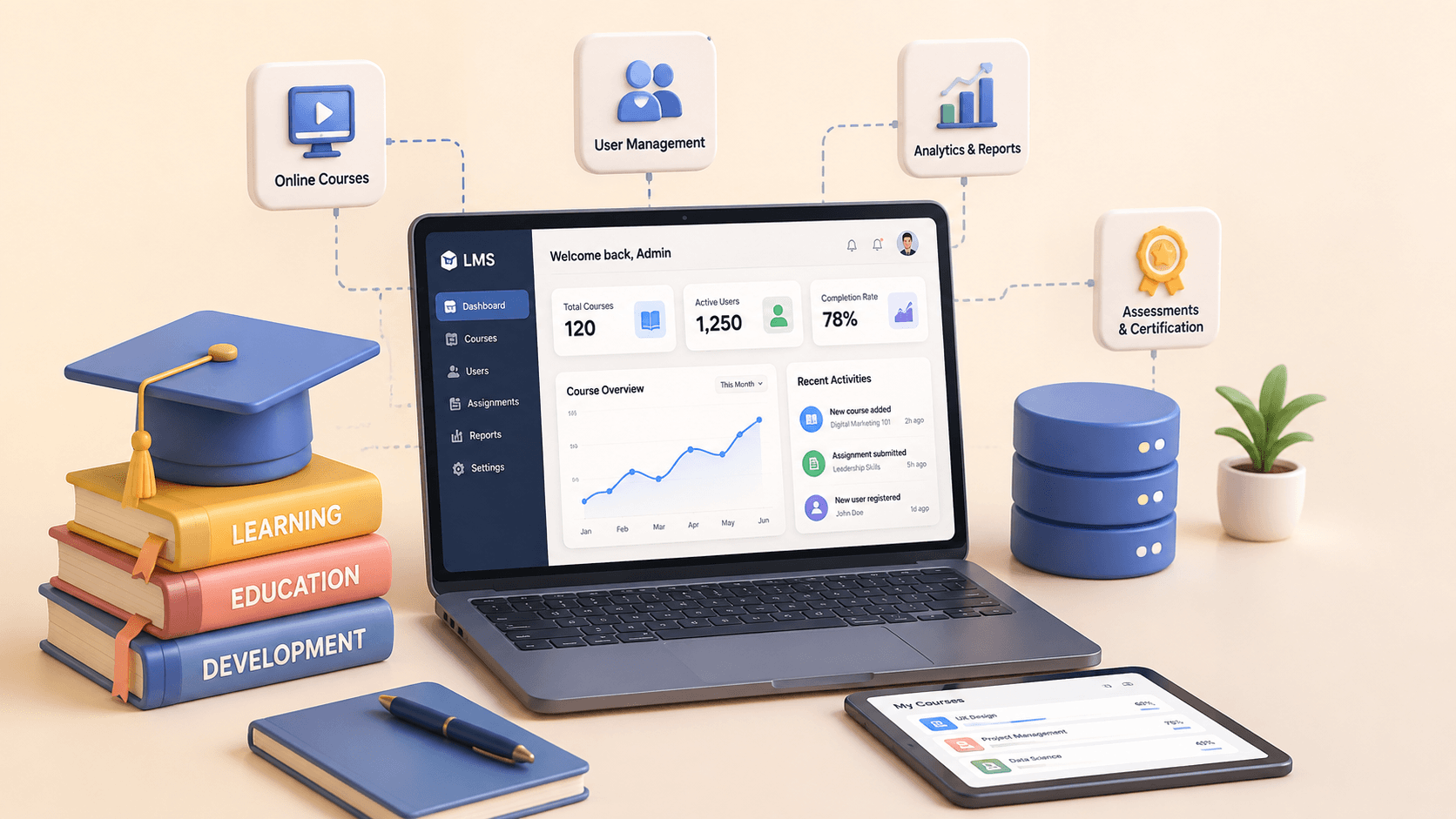
Whether you're an HR or L&D leader trying to modernize corporate training, or a founder building an EdTech product from the ground up, the same question tends to come up early: should we buy an existing learning management system, or build one custom to our actual needs? Off-the-shelf LMS platforms handle the basics well, but many organizations eventually find themselves working around limitations rather than working within a system genuinely built for them. This blog looks at when custom LMS development makes sense, and what actually goes into building one.
What an LMS Actually Needs to Do
At its core, a learning management system needs to deliver content, track progress, and provide some way to measure whether learning objectives were actually met. Beyond that baseline, requirements diverge significantly depending on whether you're running internal corporate training or building a customer-facing EdTech product.
Corporate Training vs. EdTech: Different Problems, Different Systems
Enterprise L&D teams typically need an LMS that:
- Integrates with existing HR systems and employee records
- Supports compliance training with clear completion tracking and reporting
- Handles role-based content, since different teams need different training paths
- Scales across departments, locations, or business units without added complexity
EdTech platforms, by contrast, are usually built around:
- A polished, engaging learner experience designed to keep users coming back
- Monetization built into the platform itself, whether subscription, course-based, or cohort-based
- Content delivery formats suited to a broad, often global learner base
- Analytics geared toward learner engagement and retention, not just compliance
These are genuinely different products under the same "LMS" label, which is part of why generic platforms often struggle to serve both use cases well.
Why Off-the-Shelf LMS Platforms Fall Short for Some Organizations
Established LMS platforms work well for standard use cases, but common limitations include:
- Rigid course structures that don't match how your organization actually delivers training
- Limited or costly customization for branding, workflows, or specific reporting needs
- Per-user or per-seat pricing that becomes expensive at scale
- Difficulty integrating deeply with internal systems that weren't designed with that platform in mind
For organizations with fairly standard training needs, these tradeoffs are often acceptable. For others, they become a genuine constraint on how training or the product itself can evolve.
What Custom LMS Development Actually Involves
Building a custom LMS through dedicated Custom Software Development means the platform is architected specifically around your organization's structure, content needs, and reporting requirements, rather than adapted from a generic template. This typically includes:
- Course and content management built around how your organization actually organizes material
- User roles and permissions matching your specific organizational structure
- Progress tracking and reporting tailored to what you actually need to measure
- Integration with existing systems, such as HR platforms, CRMs, or payment processors for EdTech products
Where AI Fits Into Modern LMS Development
Increasingly, custom LMS platforms incorporate AI Development Services to support features like:
- Personalized learning paths based on individual progress and performance
- Automated content recommendations tailored to a learner's role or goals
- Intelligent assessment tools that adapt difficulty based on learner responses
- Automated flagging of learners falling behind, so instructors or managers can intervene earlier
These capabilities are difficult to retrofit into a rigid off-the-shelf platform, but can be designed in from the start with a custom build.
Mobile Access Is Increasingly a Requirement, Not a Nice-to-Have
Both corporate learners and EdTech users increasingly expect to access training or courses from their phones, not just a desktop browser. Depending on the specific use case, this might mean a responsive web experience, a progressive web app, or full Mobile App Development for a dedicated learning app, particularly for EdTech products where mobile engagement often drives retention.
Compliance and Data Security Considerations
For enterprise training, particularly in regulated industries, compliance reporting and secure handling of employee data are often non-negotiable requirements. Custom development allows compliance logic and data security measures to be built precisely around your organization's specific regulatory obligations, rather than working within the generic compliance features a standard platform happens to offer.
Scalability for Growing EdTech Platforms
EdTech founders in particular need to think beyond the first version of their platform. A custom LMS built with scalability in mind avoids the costly rebuild that often follows rapid user growth on a platform that wasn't architected to handle it, supporting growing content libraries, learner volume, and feature expansion without a fundamental restructure.
Making the Build vs. Buy Decision
Rather than treating this as an all-or-nothing choice, it helps to assess:
- How standard versus unique your training or product requirements actually are
- Whether integration with existing systems is essential or optional
- How much your training needs or product will scale over the next few years
- Whether per-user licensing costs would become significant at your expected scale
Organizations with genuinely standard needs often do fine with an established platform. Those with specific compliance requirements, unique content delivery needs, or product-level differentiation tend to see stronger long-term value from a custom build.
Related Services
- Custom Software Development - building the LMS architecture specifically around your training or product requirements
- AI Development Services - powering personalized learning paths, adaptive assessments, and intelligent progress tracking
- Mobile App Development - extending course access to a dedicated mobile experience for learners
- Web Development - building the learner and administrator interfaces that make the LMS usable day to day
- Healthcare Software Development - relevant for healthcare organizations building compliance-focused training platforms
Related Blogs
- SaaS vs Custom Software: A Decision Framework
- How AI Is Changing Custom Software Developmen
- App Development Process: From Idea to App Store Launch
Frequently Asked Questions
Is a custom LMS more expensive than an off-the-shelf platform?
Upfront, generally yes, since it involves dedicated development rather than a subscription. Over time, especially at scale, avoiding per-user licensing fees can make custom development more cost-effective.
How long does it take to build a custom LMS?
It depends heavily on scope - a focused MVP for a specific training program takes considerably less time than a full-featured EdTech platform with monetization and content delivery at scale.
Can a custom LMS integrate with our existing HR software?
Yes, and this is often one of the strongest reasons enterprises choose custom development, since integration can be built precisely around the systems already in place.
Is a custom LMS a good fit for an early-stage EdTech startup?
It depends on how differentiated the product needs to be. Some startups validate their idea on a simpler platform first, then move to custom development once specific product needs become clear.
Does a custom LMS support compliance training and reporting?
Yes, and it can be built specifically around your organization's regulatory requirements, rather than relying on the generic compliance features a standard platform provides.
Weighing Build vs. Buy for Your LMS?
Frequently asked questions
Upfront, generally yes, since it involves dedicated development rather than a subscription. Over time, especially at scale, avoiding per-user licensing fees can make custom development more cost-effective.
It depends heavily on scope - a focused MVP for a specific training program takes considerably less time than a full-featured EdTech platform with monetization and content delivery at scale.
Yes, and this is often one of the strongest reasons enterprises choose custom development, since integration can be built precisely around the systems already in place.
It depends on how differentiated the product needs to be. Some startups validate their idea on a simpler platform first, then move to custom development once specific product needs become clear.
Yes, and it can be built specifically around your organization's regulatory requirements, rather than relying on the generic compliance features a standard platform provides.
Related Articles

Need help applying this?
Our team can turn the ideas in this article into a clear plan and a polished build.
Contact Us