
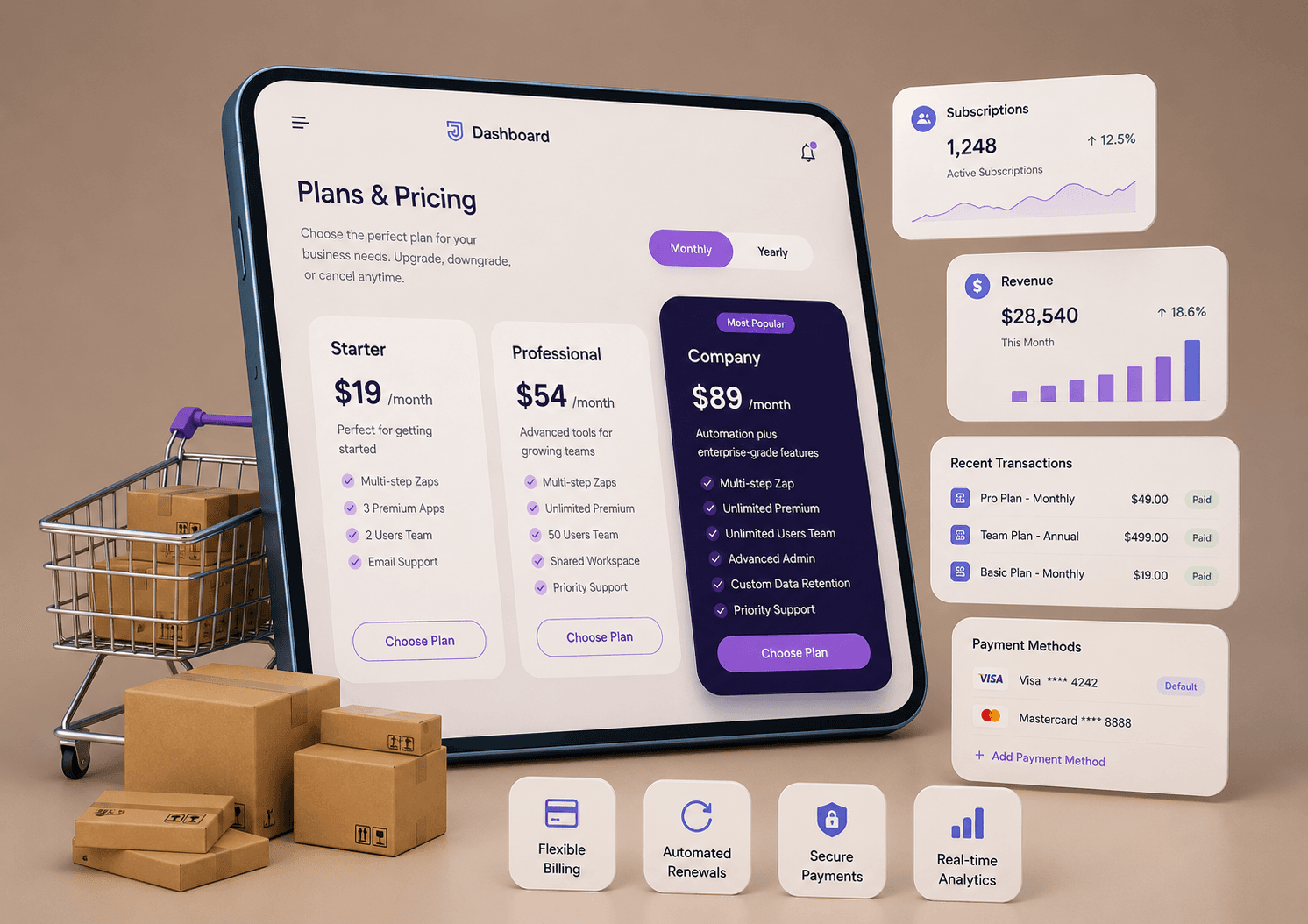
Third-party billing platforms like Chargebee or Stripe Billing are usually the right first choice for a SaaS company - fast to implement, reliable, and far cheaper than building anything custom at an early stage. But as revenue scales, many SaaS founders and finance leaders start noticing that the percentage-based fees on these platforms scale right alongside their growth, sometimes eating a meaningful slice of margin that a custom-built system wouldn't cost. This blog looks at what custom subscription billing development actually involves, and when it genuinely makes more financial sense than continuing to pay a third-party platform.
Why Third-Party Billing Platforms Are the Right Early Choice
For most early-stage SaaS businesses, using an established billing platform makes complete sense:
- Fast implementation without building payment infrastructure from scratch
- Built-in handling for PCI compliance, tax calculation, and payment security
- Established dunning and failed-payment retry logic already built and tested
- Low upfront cost, with fees scaling proportionally to revenue rather than a large fixed investment
At low to moderate transaction volume, these advantages typically outweigh the cost of the platform's fees by a wide margin.
Why the Math Changes as Revenue Scales
The friction point tends to emerge once a SaaS company reaches meaningful revenue, since most third-party billing platforms charge a percentage of processed revenue, not a flat fee. As monthly recurring revenue grows, that percentage translates into an increasingly large absolute dollar amount, and:
- Fees that felt negligible at lower volume become a significant, recurring cost
- Some platforms add tiered pricing or feature gates that require moving to more expensive plans as usage grows
- The cost of staying on a third-party platform can start to exceed what a custom-built system would cost to build and maintain
This is typically the point where SaaS finance and product leaders start seriously evaluating whether custom development makes financial sense.
What Custom Subscription Billing Development Actually Involves
Through dedicated Custom Software Development, a billing system can be architected specifically around your pricing model, customer base, and payment processor relationships, rather than adapted from a generic billing platform's assumptions. This typically includes:
- Subscription and plan management logic reflecting your actual pricing structure, including tiers, add-ons, or usage-based components
- Direct integration with a payment processor at more favorable interchange rates than a billing platform's markup
- Invoicing and receipt generation matched to your specific business and tax requirements
- Dunning and failed-payment retry logic tuned to your actual customer behavior patterns
The Real Cost Comparison: Fees vs. Build and Maintain
Deciding whether custom billing makes sense requires an honest comparison, not just a reaction to rising fee totals:
- Third-party platforms charge ongoing, percentage-based fees that continue indefinitely as revenue grows
- Custom development requires a significant upfront investment, plus ongoing maintenance costs that don't scale the same way with revenue
- The breakeven point depends heavily on revenue scale, pricing model complexity, and how much you're currently paying in platform fees
For many SaaS businesses, this breakeven arrives once monthly recurring revenue reaches a level where the platform's percentage fee, in absolute terms, exceeds what building and maintaining a custom system would cost annually.
Handling Complex Pricing Models
SaaS pricing has grown more sophisticated - tiered plans, usage-based components, seat-based pricing, hybrid models combining several approaches. Generic billing platforms handle standard versions of these well, but businesses with genuinely unique pricing logic sometimes find themselves working around platform limitations rather than within them. Custom development allows pricing logic to be built precisely around your actual model, however unconventional it may be.
Payment Processor Integration and Cost Savings
One of the more direct financial benefits of custom billing is the ability to integrate directly with a payment processor rather than routing through a billing platform's markup on top of standard processing fees. This requires building the integration, compliance handling, and security layer yourself, but removes an intermediary fee layer that compounds at scale.
Compliance and Security Considerations
Handling payment and billing data directly comes with real responsibility, including:
- PCI compliance for any system touching payment card data
- Secure storage and handling of customer billing and subscription information
- Tax calculation and compliance, particularly for SaaS businesses billing across multiple jurisdictions
- Audit trails and financial reporting accuracy for revenue recognition purposes
These aren't optional considerations - they need to be built into the system architecture from the start, since custom billing means taking on responsibility a third-party platform previously handled.
Where AI Adds Value in Subscription Billing
Beyond core billing functionality, AI Automation can improve revenue recovery and customer retention, including:
- Smart dunning logic that adjusts retry timing based on patterns in why payments actually fail
- Churn prediction based on billing and usage behavior, flagging at-risk accounts before cancellation
- Automated anomaly detection for unusual billing patterns that might indicate fraud or system errors
- Personalized upgrade or plan-change recommendations based on actual usage data
Making the Case for Custom Billing Development
Custom subscription billing development tends to deliver the strongest value when:
- Your monthly recurring revenue has reached a scale where platform fees represent a significant, growing cost
- Your pricing model has genuinely outgrown what generic billing platforms support cleanly
- You're already building substantial custom logic around a third-party platform's limitations
- Direct payment processor integration would meaningfully reduce your effective fee structure
For earlier-stage SaaS businesses, or those with fairly standard pricing models, continuing with an established billing platform typically remains the more practical and lower-risk choice.
Related Services
- Custom Software Development - architecting billing and payment systems around your actual pricing model
- AI Automation - powering smart dunning, churn prediction, and anomaly detection
- Web Development - building the billing dashboards and customer-facing account management
- Mobile App Development - extending billing and subscription management to mobile apps where relevant
Related Blogs
- SaaS vs Custom Software: A Decision Framework
- AI Automation ROI: How to Measure If It's Actually Saving You Money
- Enterprise Software vs SaaS: Making the Right Choice for Scale
Frequently Asked Questions
At what revenue point does custom billing typically make more sense than a platform like Chargebee?
It depends on your specific fee structure and pricing model, but many SaaS businesses see the breakeven arrive once the platform's percentage-based fees, in absolute dollar terms, start approaching what building and maintaining a custom system would cost.
Is it risky to build custom subscription billing instead of using an established platform?
It carries more responsibility, particularly around PCI compliance and payment security, which is why it's typically only recommended once revenue scale and pricing complexity justify the investment and risk.
Can custom billing handle complex pricing models like usage-based or hybrid tiers?
Yes, and this is often one of the strongest reasons businesses move to custom development, since generic platforms can struggle to cleanly support highly specific or unconventional pricing logic.
Does custom billing development eliminate all third-party fees?
Not entirely - payment processors still charge standard transaction fees - but it removes the additional markup a billing platform typically adds on top of those base processing costs.
Is custom subscription billing only worth it for large SaaS companies?
Generally, yes in terms of scale - it tends to make financial sense once monthly recurring revenue is high enough that platform fees represent a significant, growing cost relative to the investment required to build and maintain a custom system.
Reevaluating Your SaaS Billing Costs?
If your billing platform's fees have quietly grown from a rounding error into a real line item, that's usually a sign it's worth running the actual numbers on a custom build. Weboraz architects billing and payment systems around your specific pricing model and payment processor relationships, with compliance and security built in from the start. Contact Us to talk through whether custom billing makes financial sense at your current scale.
Frequently asked questions
It depends on your specific fee structure and pricing model, but many SaaS businesses see the breakeven arrive once the platform's percentage-based fees, in absolute dollar terms, start approaching what building and maintaining a custom system would cost.
Yes, and this is often one of the strongest reasons businesses move to custom development, since generic platforms can struggle to cleanly support highly specific or unconventional pricing logic.
Not entirely - payment processors still charge standard transaction fees - but it removes the additional markup a billing platform typically adds on top of those base processing costs
It carries more responsibility, particularly around PCI compliance and payment security, which is why it's typically only recommended once revenue scale and pricing complexity justify the investment and risk.
Generally, yes in terms of scale - it tends to make financial sense once monthly recurring revenue is high enough that platform fees represent a significant, growing cost relative to the investment required to build and maintain a custom system.
Related Articles


Need help applying this?
Our team can turn the ideas in this article into a clear plan and a polished build.
Contact Us