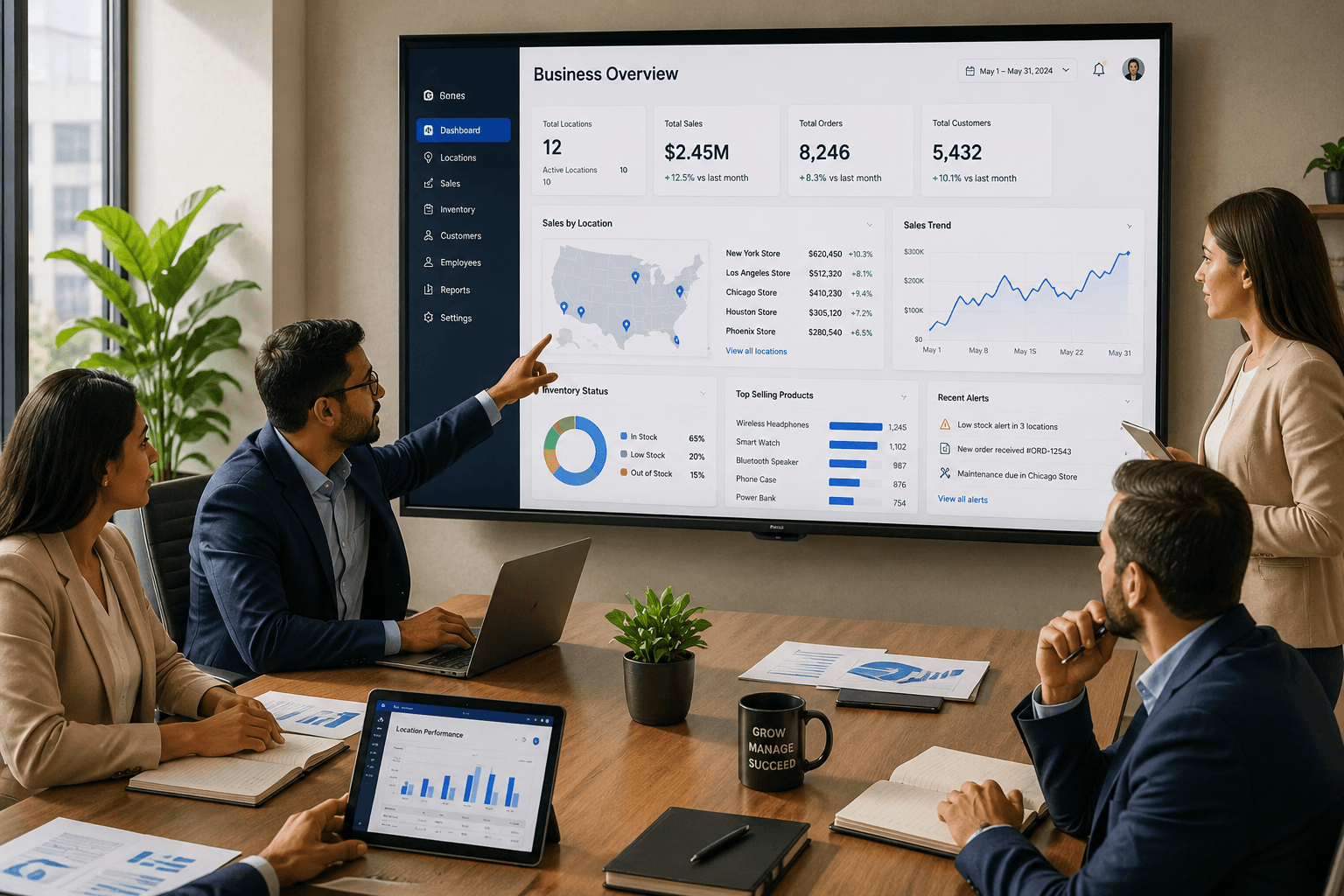
Most enterprises already have dashboards showing what happened last quarter, last month, even yesterday. What they're increasingly missing is the ability to answer a different question: what's likely to happen next, and what should we do about it now. That's the gap predictive analytics is built to close, and it's why more enterprise leaders are moving past standard reporting tools toward custom AI-driven forecasting. This blog looks at what predictive analytics development actually involves, and why it's become a serious priority for enterprises making high-stakes decisions.
Why Standard Reporting Isn't Enough Anymore
Traditional business intelligence tools are built to summarize the past - what sold, what didn't, what trends emerged over a given period. That's valuable, but it's fundamentally backward-looking. Enterprise decisions, particularly around inventory, staffing, risk, and investment, depend on understanding what's likely to happen next, not just what already occurred. Predictive analytics addresses this gap directly by using historical and real-time data to forecast future outcomes with measurable confidence.
What Predictive Analytics Actually Involves
At its core, predictive analytics combines statistical modeling, machine learning, and enterprise data to identify patterns and project them forward. This typically includes:
- Analyzing historical data to identify meaningful patterns and correlations
- Building models that forecast future outcomes based on those patterns
- Continuously refining models as new data becomes available
- Presenting predictions in a way decision-makers can actually act on, not just observe
The goal isn't a single static forecast - it's an ongoing capability that improves as more data flows through the system.
Why This Requires Custom Development, Not Generic Tools
Off-the-shelf analytics platforms often offer basic forecasting features, but enterprise predictive analytics solutions typically require something more tailored, since:
- Enterprise data structures and sources are rarely standard enough for a generic tool to model accurately
- The specific business questions worth forecasting differ significantly by industry and company
- Integration with existing enterprise systems demands custom architecture, not a plug-and-play dashboard
- Model accuracy improves significantly when built around the business's actual decision-making context, not a generalized use case
This is where dedicated Custom Software Development becomes essential - building a predictive system architected specifically around how your enterprise actually operates and decides.
Common Enterprise Use Cases for Predictive Analytics
Predictive analytics applies across a wide range of enterprise functions, including:
- Demand forecasting for inventory and supply chain planning
- Customer churn prediction to guide retention strategy
- Financial forecasting for budgeting and risk management
- Predictive maintenance for equipment-heavy operations
- Workforce planning based on projected demand and capacity
Each use case requires its own data sources, modeling approach, and validation process, which is part of why a one-size-fits-all tool rarely delivers the accuracy enterprises actually need.
The Data Foundation Predictive Analytics Depends On
Predictive models are only as reliable as the data feeding them. Before development begins, enterprises typically need to address:
- Data quality and consistency across different internal systems
- Integration between disparate data sources that weren't originally designed to connect
- Sufficient historical data volume to train models with meaningful accuracy
- Ongoing data pipelines that keep models updated with current information
Skipping this foundational work is one of the most common reasons predictive analytics initiatives underdeliver on their promise.
How AI Fits Into Predictive Analytics Development
Modern predictive analytics increasingly relies on machine learning models that improve automatically as more data becomes available, rather than static statistical formulas that stay fixed over time. This is where AI Development Services become central to the build - designing models that learn and adapt, rather than requiring manual recalibration every time business conditions shift.
Making Predictions Actionable, Not Just Visible
A forecast that sits in a dashboard nobody acts on delivers little real value. Effective predictive analytics systems are built with decision-making in mind from the start, including:
- Clear, interpretable outputs decision-makers can trust and understand
- Alerts or triggers tied to specific forecasted thresholds
- Integration into existing workflows, rather than a separate tool people have to remember to check
Measuring the ROI of Predictive Analytics Investment
Given the scale of investment typically involved, enterprises should define clear success metrics upfront - reduced forecasting error, faster decision cycles, cost savings from better planning - rather than treating predictive analytics as inherently valuable without measurable outcomes tied to specific business goals.
Where This Fits Into a Broader Enterprise Technology Strategy
Predictive analytics rarely exists in isolation. It typically connects to broader enterprise systems, and businesses exploring this capability often benefit from a technology partner who understands both the AI modeling work and the surrounding Web Development and system integration required to make predictions genuinely usable across the organization.
Related Services
Related Blogs
Frequently Asked Questions
What is the difference between predictive analytics and standard business reporting?
Standard reporting summarizes past performance, while predictive analytics uses historical and real-time data to forecast likely future outcomes, supporting proactive rather than reactive decisions.
Why do enterprises need custom predictive analytics development instead of off-the-shelf tools?
Enterprise data structures, decision-making context, and integration needs are typically too specific for generic tools to model accurately, making custom development more reliable for high-stakes forecasting.
How much historical data is needed to build an accurate predictive model?
It varies by use case, but generally, more consistent, high-quality historical data leads to more reliable models - insufficient or inconsistent data is a common reason predictive initiatives underperform.
What enterprise functions benefit most from predictive analytics?
Demand forecasting, financial planning, customer churn prediction, predictive maintenance, and workforce planning are among the most common and high-value applications.
How is the ROI of a predictive analytics investment measured?
Through specific metrics defined upfront - such as forecasting accuracy improvements, cost savings from better planning, or faster decision cycles - rather than treating the capability as inherently valuable without measurable outcomes.
Considering Predictive Analytics for Your Enterprise?
Building an effective predictive analytics solution requires more than choosing the right AI model. Success depends on high-quality data, scalable architecture, and seamless integration with your existing business systems.
At Weboraz, we help businesses design and develop custom AI-powered predictive analytics solutions tailored to their operational goals and decision-making processes.
If you're exploring predictive analytics for your organization, contact our team to discuss your requirements and discover how a custom solution can help you make faster, data-driven decisions.