
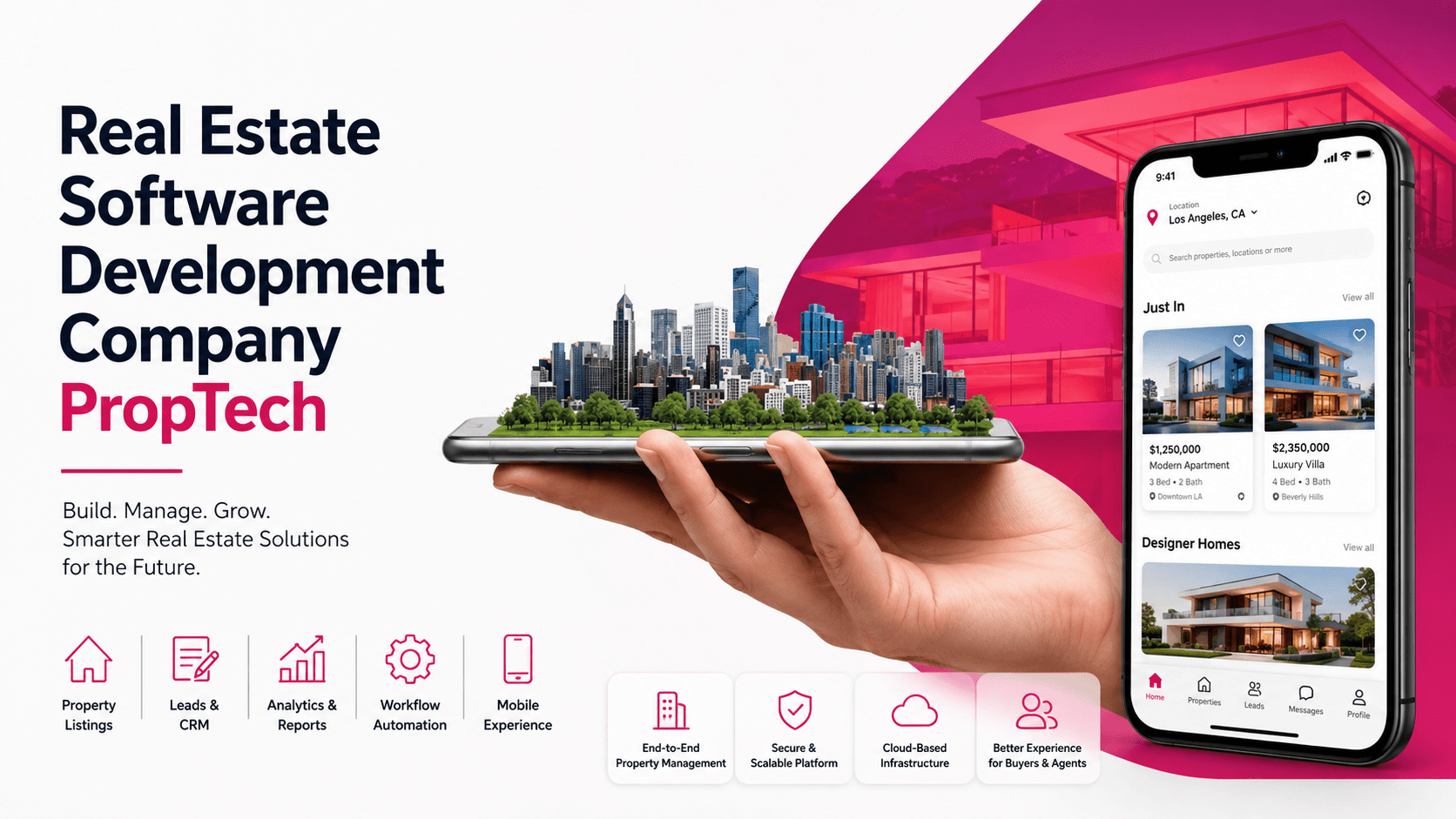
Whether you're a property management firm juggling tenant requests across a dozen disconnected tools, or a PropTech founder trying to build a product that actually stands out in a crowded market, the software question tends to land in the same place: generic tools cover the basics, but rarely fit exactly how real estate businesses actually operate. This blog looks at what real estate software development actually involves, for both property management operations and ground-up PropTech products, so you can figure out what your specific situation actually calls for.
Two Very Different Real Estate Software Problems
"Real estate software" covers a lot of ground, and it's worth separating the two most common starting points clearly:
- Property management software - built to run day-to-day operations for an existing portfolio: leasing, maintenance, rent collection, tenant communication
- PropTech products - new, often customer-facing platforms built to solve a specific real estate problem at scale, frequently with a monetization model built in from day one
These are genuinely different builds under the same umbrella term, and conflating them is one of the more common early planning mistakes.
What Property Management Software Actually Needs to Handle
For firms managing existing properties, the software needs to support daily operational reality:
- Tenant and lease management, including renewals, communication, and document handling
- Maintenance request tracking, from submission through resolution
- Rent collection and financial reporting across units or properties
- Owner reporting, for firms managing properties on behalf of others
- Vendor and contractor coordination for repairs and upkeep
Off-the-shelf property management platforms cover most of this reasonably well for standard residential or commercial portfolios - the friction tends to show up with mixed-use properties, unusual lease structures, or firms managing across multiple, meaningfully different property types.
Why Off-the-Shelf Property Management Tools Sometimes Fall Short
Common limitations firms run into as they grow include:
- Rigid workflows that don't match how a specific portfolio actually operates
- Per-unit or per-property pricing that scales expensively as a portfolio grows
- Limited integration with accounting systems, CRMs, or tools the firm already relies on
- Reporting that doesn't reflect the specific metrics owners or investors actually want to see
For firms with a fairly standard portfolio, these tradeoffs are often acceptable. For firms with more complexity - mixed residential and commercial, multiple entities, specific compliance needs - the constraints become a real operational tax.
Building Custom Property Management Software
Custom Custom Software Development for property management means the platform gets architected around the firm's actual portfolio structure, ownership relationships, and reporting requirements, rather than adapted from a generic template. This typically includes:
- Portfolio structures that reflect real ownership and management relationships, not a flattened, generic hierarchy
- Automated rent collection and late-fee handling tuned to actual lease terms
- Maintenance workflows that route requests to the right vendor automatically
- Owner-facing dashboards showing exactly the financial detail each owner actually wants
What PropTech Founders Are Actually Building
PropTech products take a different shape entirely, since they're usually solving a specific market problem rather than running internal operations. Common categories include:
- Marketplace platforms connecting buyers, renters, or investors with properties
- Tools for real estate professionals - agents, brokers, appraisers - to work more efficiently
- Investment and fractional ownership platforms
- Smart building or IoT-connected property management tools
Each of these has different technical demands, but they share a common need: a platform built specifically around the product's actual differentiation, not a generic real estate app template.
Where AI Fits Into Modern Real Estate Software
Real estate generates a lot of structured and unstructured data - listings, lease terms, maintenance history, market trends - that lends itself well to AI Automation, including:
- Automated tenant screening and application processing
- Predictive maintenance flagging based on property and equipment history
- Smart pricing recommendations for rentals or listings based on market data
- Automated lead qualification for PropTech platforms handling high inquiry volume
For property managers, this tends to reduce manual administrative load. For PropTech products, intelligent features are increasingly a genuine differentiator rather than a nice-to-have.
Mobile Access Matters on Both Sides of Real Estate Software
Property managers, maintenance staff, and tenants all increasingly expect mobile access - submitting a maintenance request, checking a lease document, or approving a repair shouldn't require logging into a desktop portal. Through Mobile App Development, this typically means a tenant-facing app for requests and payments, alongside field tools for maintenance staff working on-site. PropTech products, particularly consumer-facing marketplaces, are often mobile-first by necessity, since that's simply where buyers and renters are searching.
Integration With Real Estate-Specific Systems
Real estate software rarely operates in isolation. Property management platforms often need to connect with accounting systems, MLS data feeds, or payment processors, while PropTech platforms may need integrations with listing services, mapping tools, or third-party verification services. Building these integrations properly is frequently the difference between a system that genuinely centralizes operations and one that just adds another disconnected screen to check.
Compliance and Data Considerations in Real Estate Software
Real estate software often handles sensitive data - tenant financial and personal information, lease agreements, payment details - which makes secure data handling and relevant compliance requirements a real consideration during development, not an afterthought addressed after launch.
Deciding Between Custom Development and an Existing Platform
The right path generally comes down to:
- How standard your property types, lease structures, or workflows actually are
- Whether per-unit or per-user licensing costs are becoming significant as you scale
- Whether your differentiation, for PropTech founders, depends on functionality a generic platform simply can't offer
- How much integration with existing systems matters to daily operations
Firms and founders with genuinely standard needs often do fine with established platforms. Those with real operational complexity or product-level differentiation tend to see stronger long-term value from a custom build.
Related Services
- Custom Software Development - architecting property management or PropTech platforms around your real operations
- AI Automation - powering tenant screening, predictive maintenance, and smart pricing
- Mobile App Development - building tenant, field, and PropTech mobile experiences
- Web Development - building management dashboards and customer-facing PropTech platforms
Related Blogs
- Custom CRM vs Off-the-Shelf CRM: A Real Cost Comparison
- Enterprise Software vs SaaS: Making the Right Choice for Scale
- Software Integration 101: Making Your Tools Work Together
- How to Write a Software Requirements Document
Frequently Asked Questions
What's the difference between property management software and PropTech?
Property management software runs internal operations for an existing portfolio, while PropTech typically refers to customer-facing products solving a broader real estate market problem, often with its own monetization model.
Why do property management firms outgrow off-the-shelf software?
Generic platforms are built for standard portfolios, so firms with mixed property types, unusual lease structures, or specific reporting needs often start running into workflow and integration limitations as they grow.
How does AI automation help in real estate software specifically?
It can automate tenant screening, flag predictive maintenance needs, and support smart pricing recommendations, reducing manual administrative work and, for PropTech products, adding genuine differentiation.
Is custom real estate software only worth it for large property management firms?
Not necessarily. It tends to make sense once operational complexity, licensing costs, or product differentiation needs outweigh the convenience of a generic platform, regardless of portfolio size.
What compliance considerations apply to real estate software?
Real estate platforms often handle sensitive tenant financial and personal data, making secure data handling and relevant compliance requirements an important part of development from the start.
Considering a Custom Real Estate Software Build?
Whether you're running a growing property portfolio or building a PropTech product from scratch, generic software tends to fit only part of what you actually need. Weboraz builds real estate platforms architected around your specific portfolio, workflows, or product vision, with automation applied where it genuinely reduces manual work. Contact Us to talk through what a system built for your actual real estate business would look like.
Frequently asked questions
Property management software runs internal operations for an existing portfolio, while PropTech typically refers to customer-facing products solving a broader real estate market problem, often with its own monetization model
Generic platforms are built for standard portfolios, so firms with mixed property types, unusual lease structures, or specific reporting needs often start running into workflow and integration limitations as they grow.
It can automate tenant screening, flag predictive maintenance needs, and support smart pricing recommendations, reducing manual administrative work and, for PropTech products, adding genuine differentiation.
Not necessarily. It tends to make sense once operational complexity, licensing costs, or product differentiation needs outweigh the convenience of a generic platform, regardless of portfolio size.
Real estate platforms often handle sensitive tenant financial and personal data, making secure data handling and relevant compliance requirements an important part of development from the start.
Related Articles


Need help applying this?
Our team can turn the ideas in this article into a clear plan and a polished build.
Contact Us